
Ancient drawings
The result of extensive research, the ancient drawings cabinet reflects Abraham & Wolff’s ambition to foster a dialogue between works beyond periods and traditional categories. It follows in the footsteps of exhibitions held by Galerie Jocelyn Wolff devoted to Eugène Carrière or the art of grisaille, as well as the show dedicated to Roger Caillois and the art of painted stone presented at Abraham & Wolff.
Bringing together different eras and sensibilities, the inventory spans from the 16th to the early 20th century and includes drawings by Josef Kriehuber (1800–1876), Louis-François Cassas (1756–1827), Pierre Ozanne (1737–1813) or Pierre Lélu (1741–1810). A significant place is also given to anonymous works, whose origins—century, geographical area, or the artistic environment surrounding the artist—can be clarified through in-depth study. This particular selection is guided by the idea that quality does not necessarily depend on a prestigious attribution.
The cabinet embraces a wide variety of styles and subjects: real or imaginary landscapes, fantasies, scenes inspired by Greco-Roman mythology, portraits, and genre scenes, revealing the richness and continuity of drawing practices across the centuries.
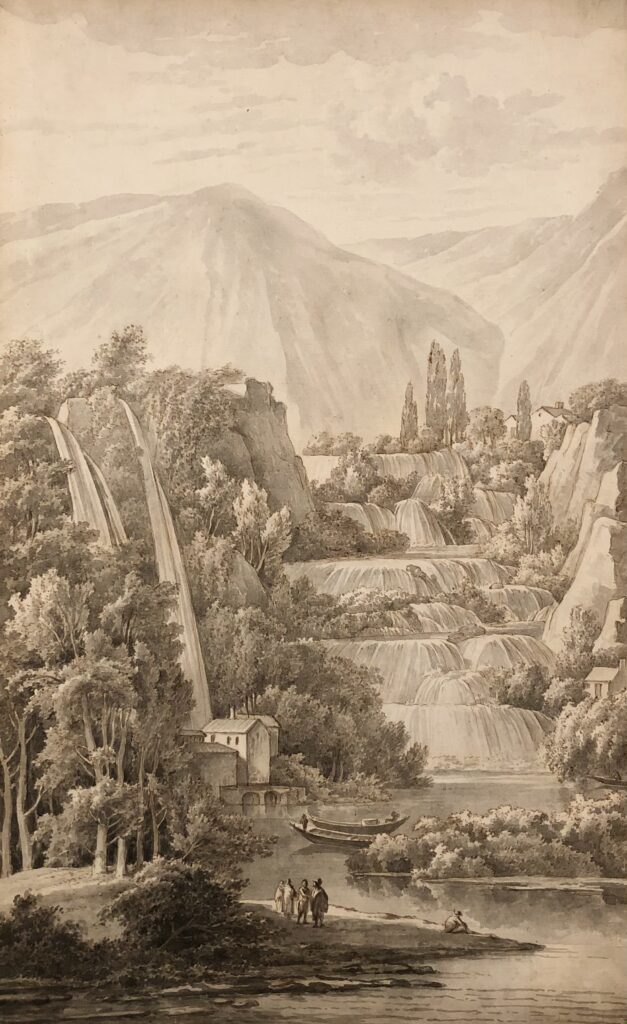
After training as an engineer with the Ponts et Chaussées and a period in the studio of Jean-Jacques Lagrenée, Louis-François Cassas travelled with the Duke of Rohan-Chabot to Naples, then to Istria and Dalmatia (present-day Croatia). Twenty years later he was asked to return in order to produce a hundred engraved plates documenting his travels in a region that was still little explored at the end of the 18th century. Our drawing appears to be the first conception for the engraving in the Victoria & Albert Museum, likely produced upon his return to Rome from his first journey in 1782. Several changes were made in the meantime: the figures animating the landscape, the sails of the boats, the trees and shrubs serving as a kind of natural backdrop, the shifting depths of the foaming waters of the falls… Besides offering us a sublime landscape—now a national park—this work demonstrates how this great travelling landscape artist combined documentary topography with artistic refinement.
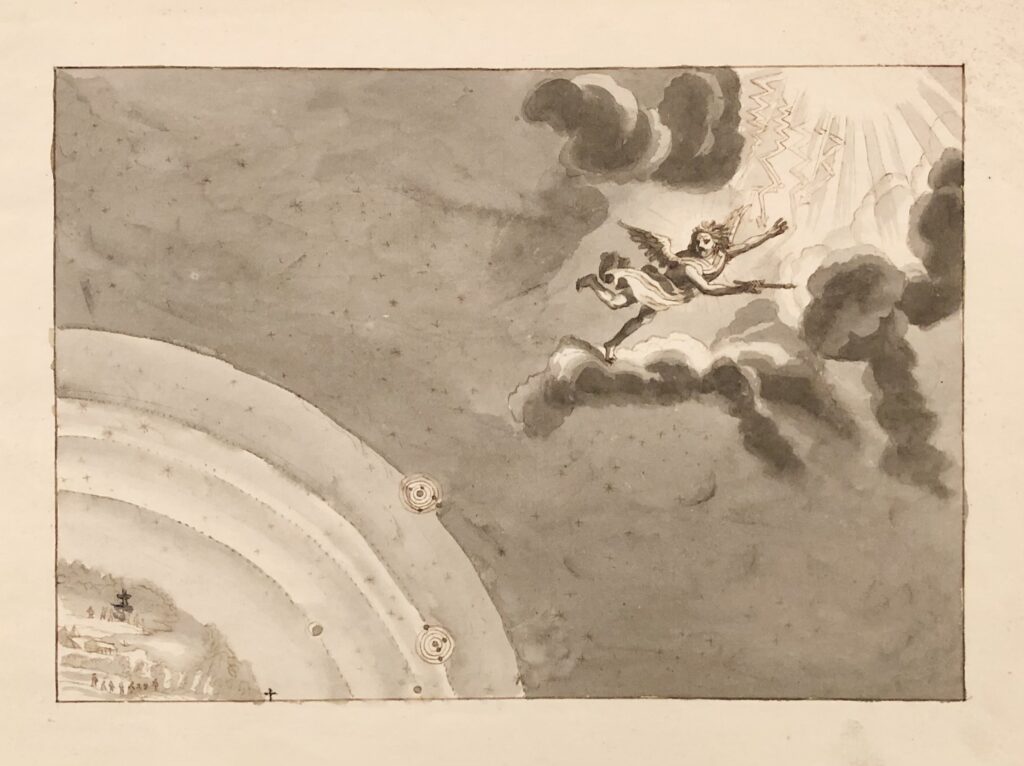
The dating of this sheet is determined by its watermark, that of the Dutch papermakers Dirk and Cornelis Blauw, associated in 1750. Since Cornelis died in 1762, the drawing can therefore be dated between 1750 and 1762. As the Netherlands exported their paper throughout Europe, this work is not necessarily by a Dutch hand. Here, the author seems not to have assimilated the discoveries of Copernicus or Kepler. The moon, and apparently the planets with their satellites, appear to revolve around an Earth peopled by small human figures next to a church. The orbits are clearly delineated—around the Earth, then around each planet. Stars shine in the cosmos. At the top, the sun sends out rays as well as bolts of lightning. An archangel seems to command it, and clouds form an atmosphere around the sun. These delightful naïvetés remind us that Copernicus’s writings establishing heliocentrism remained on the Church’s Index of prohibited books until… 1835!
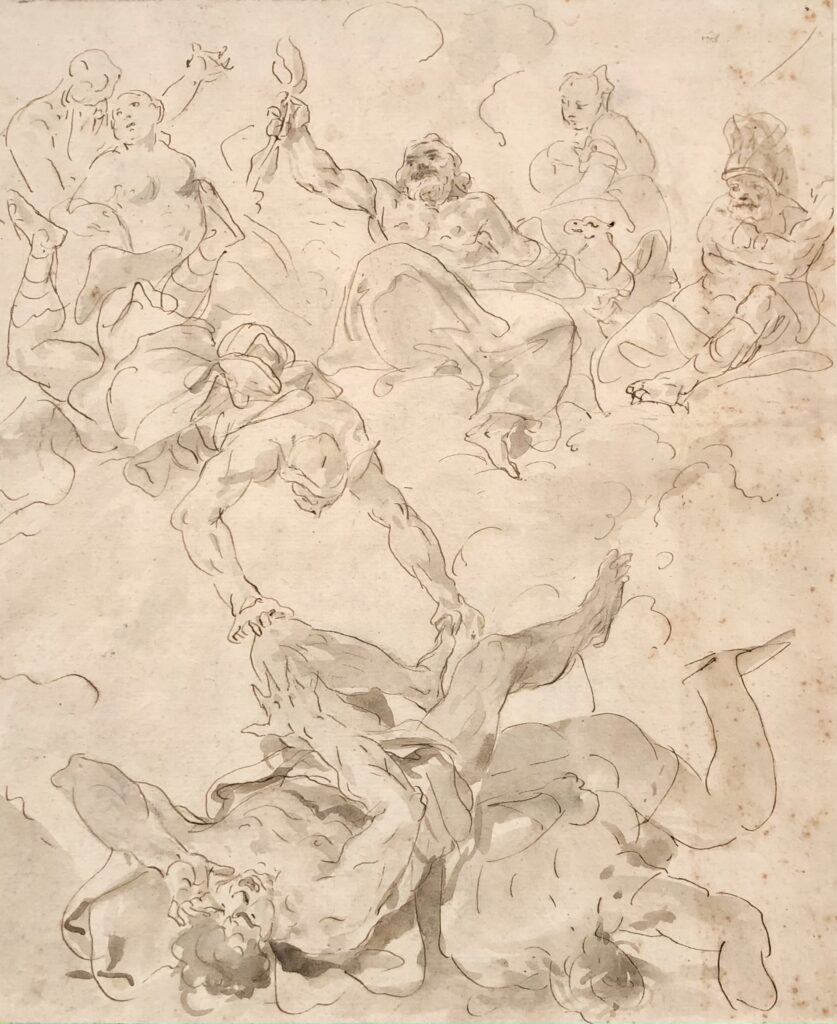
In Hesiod’s Theogony, the Titans attempt to seize the celestial realm. The scene depicted here shows Jupiter, wielding his thunderbolt in his right hand and surrounded by other Olympian Gods (including Mercury on the right side of the composition), striking the Titans with lightning. To the left of the angered god stands his eagle, symbol of the link between sky and earth. At the centre of the composition the Titans collapse, among them Typhon, instigator of the uprising.
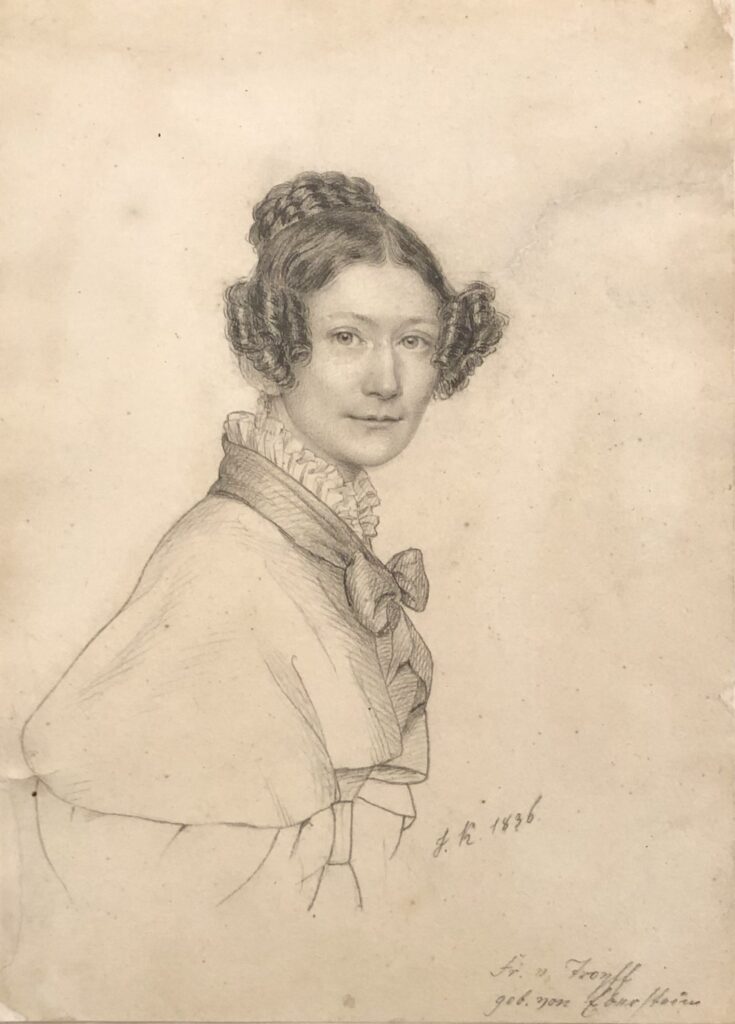
With three thousand lithographs, hundreds of watercolours, and more than two hundred paintings, Josef Kriehuber was the leading portraitist of Biedermeier Vienna. All the city’s prominent personalities, as well as passing visitors, sat for him: the high aristocracy, writers, musicians (Liszt, Schumann, Schubert, etc.), and of course the imperial family, beginning with Emperor Franz Joseph and Empress Sisi.