
Santiago de Paoli, Riding Hot
11 September — 10 October, 2026
Santiago de Paoli develops an experimental practice in which painting asks to be felt rather than analyzed. He creates fundamentally ambiguous images, where crescent moons, landscapes, bodies, domestic objects, and organic forms coexist without their presence ever being reducible to a narrative logic or an identifiable symbolism.
Incorporating unexpected materials such as wood, copper, cork stoppers, candles, and even peanuts, his works disrupt conventional hierarchies between the noble and the ordinary, the precious and the trivial. They oscillate between an almost religious gravity and an innocent humor, between mystery and naivety, familiarity and incongruity.
Since settling in Stamford, New York, where he leads a life largely removed from the demands of the outside world, Santiago de Paoli’s work has taken on a new scale. The spaciousness of his studio has enabled him to engage with more ambitious formats and to establish a physical relationship with painting. The studio is no longer merely a site of production: its contents and configuration now find their way into the works themselves, blurring the boundaries between workspace and artwork.
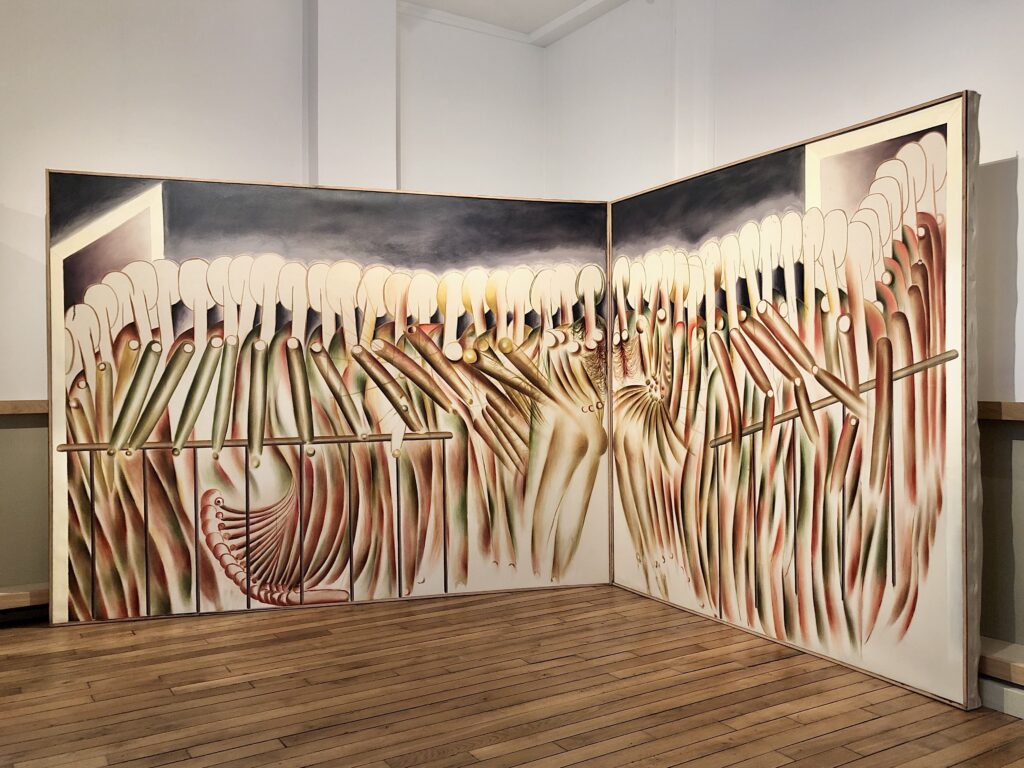
Riding Hot brings together two large-scale works created in this context. Although distinct, they share the same title: Distant Call.
One of them is a diptych conceived specifically for Abraham & Wolff. It is structured around two doorframes positioned at either end, echoing the very layout of the artist’s studio. From each opening emerges a procession of figures that resemble puppets more than human beings. They follow and overlap one another as if in a chronophotograph, where time and movement are broken down. Having reached the end of their trajectory, at the edge of each canvas, they meet and respond to one another through two characters who show each other their buttocks — a recurring motif in de Paoli’s work. The composition unfolds in a single sweeping movement, as if these figures possessed the power to transgress the material limits of their support, with only the railings running across the foreground on either side keeping them within the frame.
The other Distant Call is not stretched on a frame. Its lower section rests directly inside the gallery display window — previously on the floor of the artist’s studio —emphasizing its materiality. It depicts an almost abstract figure caught between a curtain and a large window. Beyond it lies a landscape composed of a sunflower field, a grove of strange trees, and rolling hills. At the foot of the painting stands a bouquet of real sunflowers, creating the impression that the painted flowers have materialized within the exhibition space, or conversely, that the sunflowers have entered the painting. The entire scene is organized around the tension between this exterior into which the gaze is drawn and the merely suggested interior, between the painted flower and the real flower, and the porous boundary between the inside and outside of the work itself.
While their shared title, Distant Call, lends itself to multiple interpretations, the two works nonetheless resist any definitive reading. They do not invite the viewer to solve a riddle but rather to inhabit an uncertainty that seems to emerge directly from a dream — like this tractor transformed into a penis and parked on a hillside.
Riding Hot unfolds across two Parisian venues, Abraham & Wolff and Galerie Jocelyn Wolff. The latter will host Santiago de Paoli’s exhibition from 10 September to 7 November, 2026, at 1 rue de Penthièvre, 75008 Paris.