
Archives: expositions
les expositions
Franziska Krumbachner, Filling gaps
01.16 — 03.07.2026
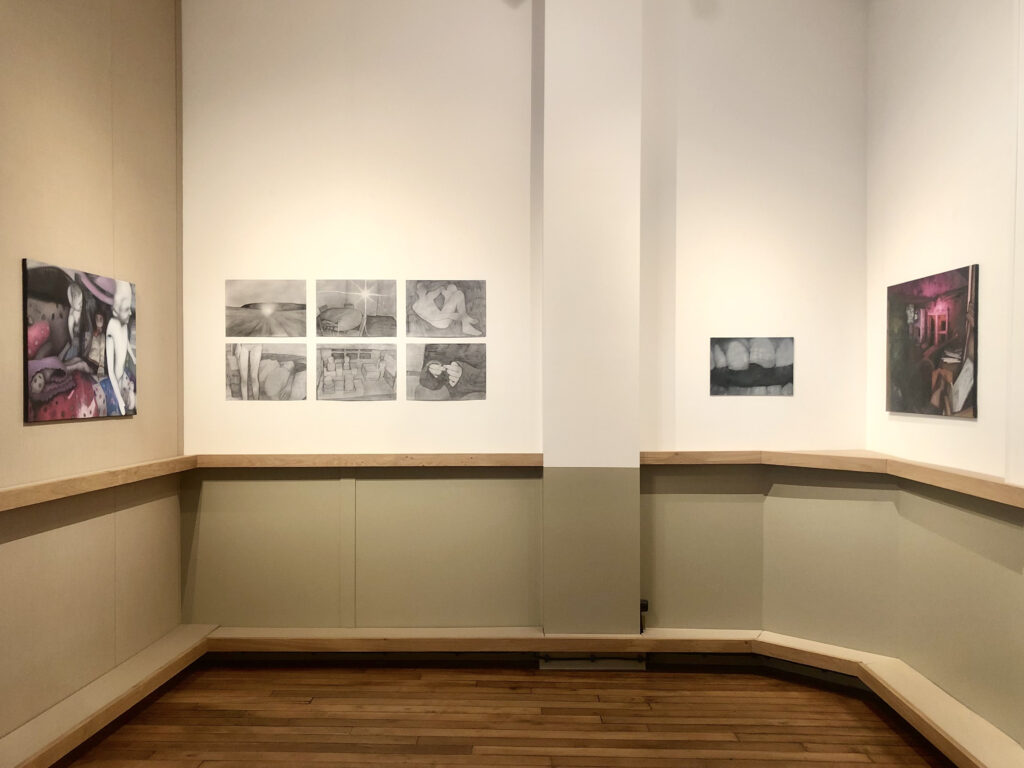
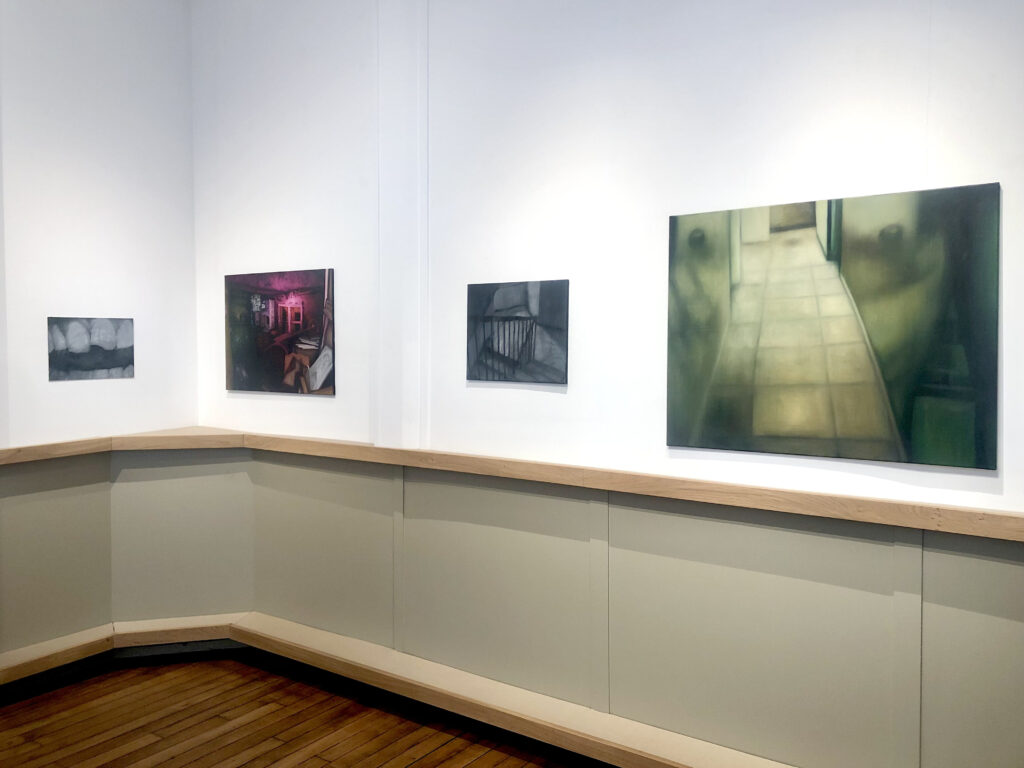
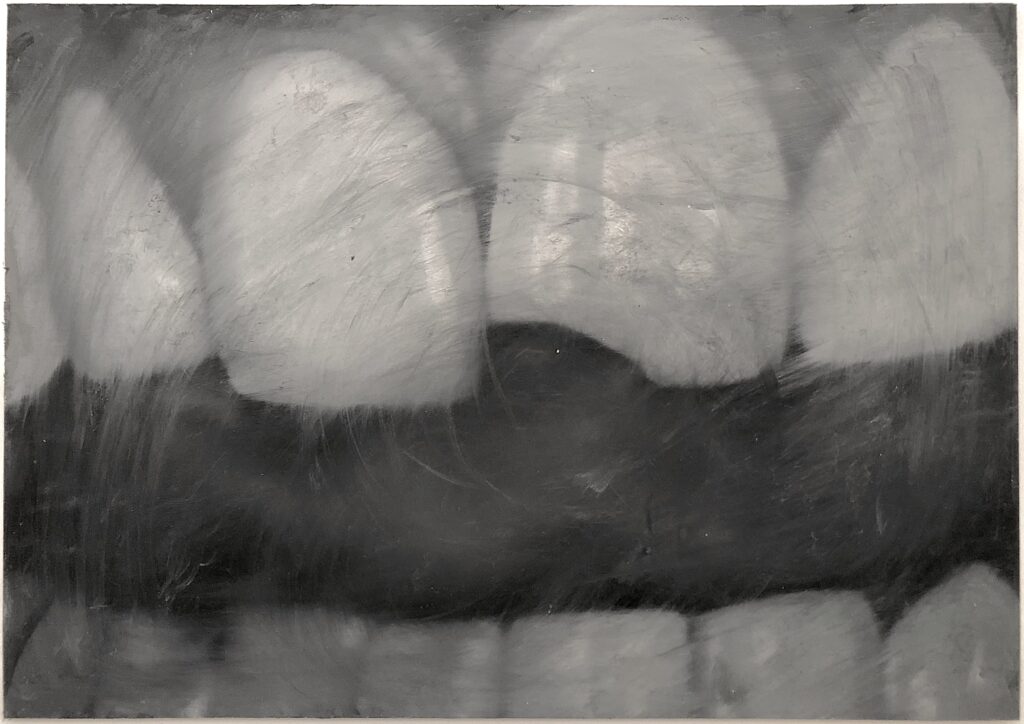
The work of Franziska Krumbachner (born in 2002) is rooted in a deeply introspective and autobiographical approach. It resembles a diary driven by the urgency to give a tangible form to lived experience. Paintings and drawings assemble fragments of an often traumatic memory, as the artist confronts her inner wounds. “I am an oil painter, and my art is much more than just a form of expression—it is my language, my anchor. […] It helps me make the unspeakable visible and navigate a world that often feels overwhelming.” (Statement collected on the occasion of the group exhibition And This is Us 2025 – Young Artists Based in Frankfurt, Frankfurter Kunstverein, Germany, 2025).
The theme of childhood occupies an important place in her artworks. Through her portraits of children, as well as multiple references—dolls, stuffed animals, playgrounds—the artist evokes this crucial period when one is vulnerable, dependent, without clear moral reference points or the capacity for expression. Childhood appears here as a time of extreme exposure to the world, during which invisible fractures open up and go on to leave lasting marks on memory and the body.
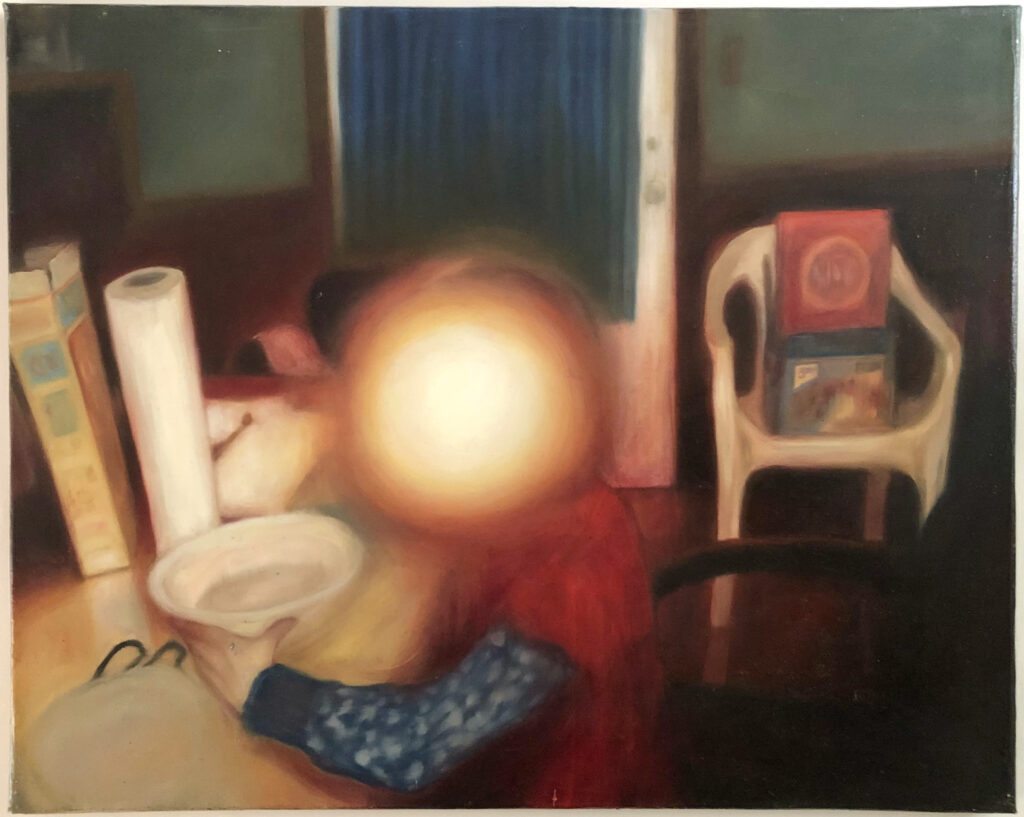
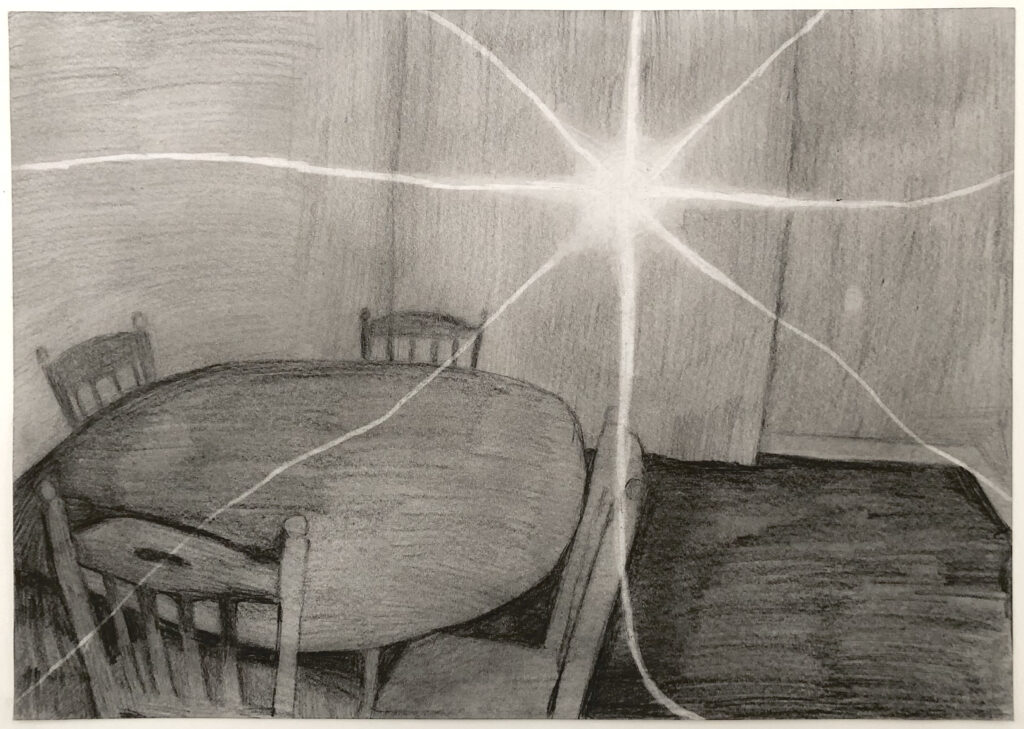
Other recurring motifs — confined spaces, car interiors, narrow corridors, curled-up bodies, or distorted faces — originate in dreams and memories that resurface like flashbacks. Each image, each vision, seems to lead back to the place of a sudden rupture. They invoke an implicit event, a story that can be sensed without ever fully revealing itself, yet whose emotional stakes assert themselves unmistakably. Everything is suggested: a table, empty chairs, a house, a simple face are enough to powerfully convey solitude, pain, and fragility. This is where the intensity of her work lies, in its narrative dimension born from the tension between what is revealed and what is repressed.
This sense of narrativity is further emphasized by viewing angles that recall the language of cinema and photography. The works appear as snapshots captured through the gaze of a protagonist immersed in the scene. The viewer is thus drawn in, placed in the position of a witness rather than a voyeur. This way of directing the gaze and confronting figures and objects undoubtedly owes much to a singular use of imagery.
While Franziska Krumbachner draws the core of her material from lived experiences, she also relies on personal photographs or images gathered online. These serve as an anchor, a point of departure from which she then develops a vision freed from its model, and even from reality itself. Although her work is based on precise and meticulous drawing, it breaks indeed with realism. This is evident in the strange rays of light that burst toward the viewer, underscoring the symbolic importance of a place or an object. Or in the technique of scraping and rubbing the paint, particularly in compositions executed in grisaille. More significantly still, the artist has developed an experimental practice of digital collage, whose hybrid compositions are subsequently transposed onto canvas. Through subtle plays of transparency, she layers heterogeneous elements, translating the complex sedimentation of memory and the coexistence of different temporalities and different realities within a single mental space.
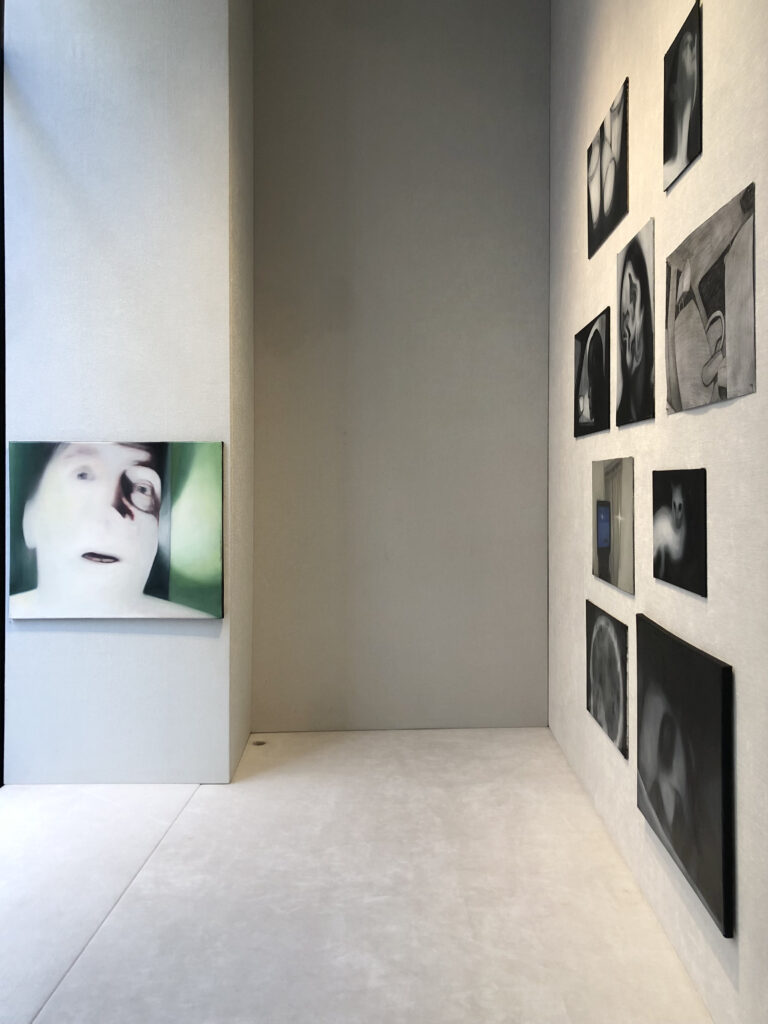
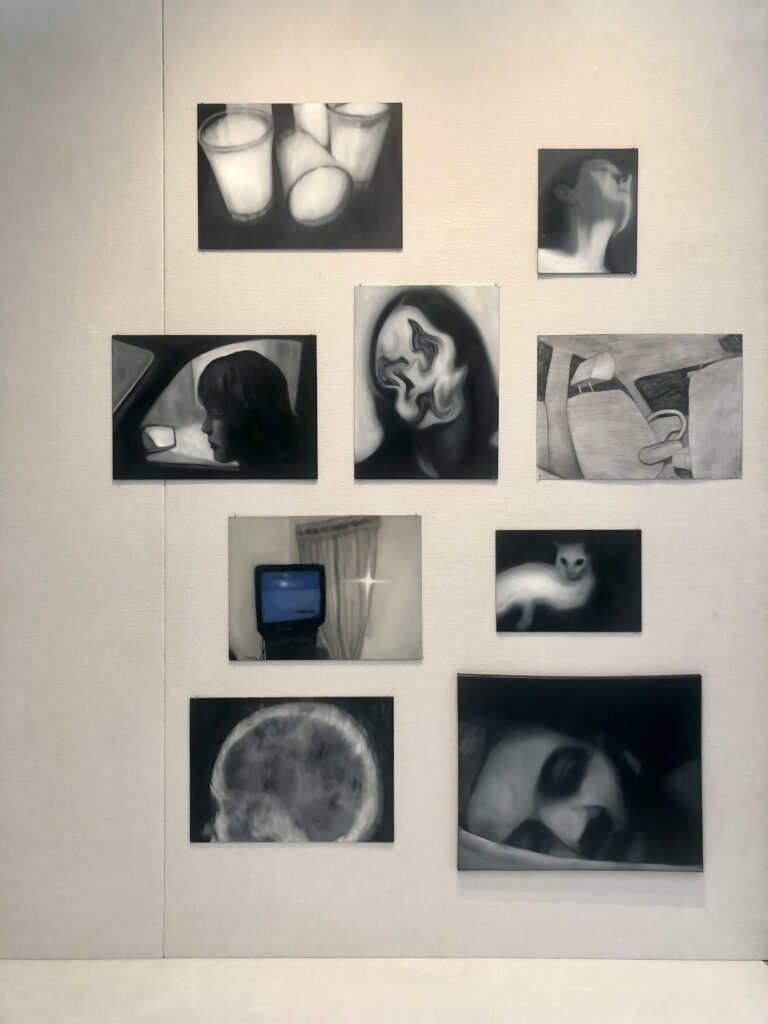
Franziska Krumbachner studied at the Hochschule für Gestaltung Offenbach, Germany. Her work has notably been presented in the group exhibition And This is Us 2025 – Young Artists Based in Frankfurt, Frankfurter Kunstverein, Germany, 2025. Filling gaps is her very first gallery exhibition.
Amorelle Jacox, They turn into days
10.18.2025 – 01.10.2026
“Mother time bore quantum seeds
What happens to the seeds
They turn into days.“
Amorelle Jacox
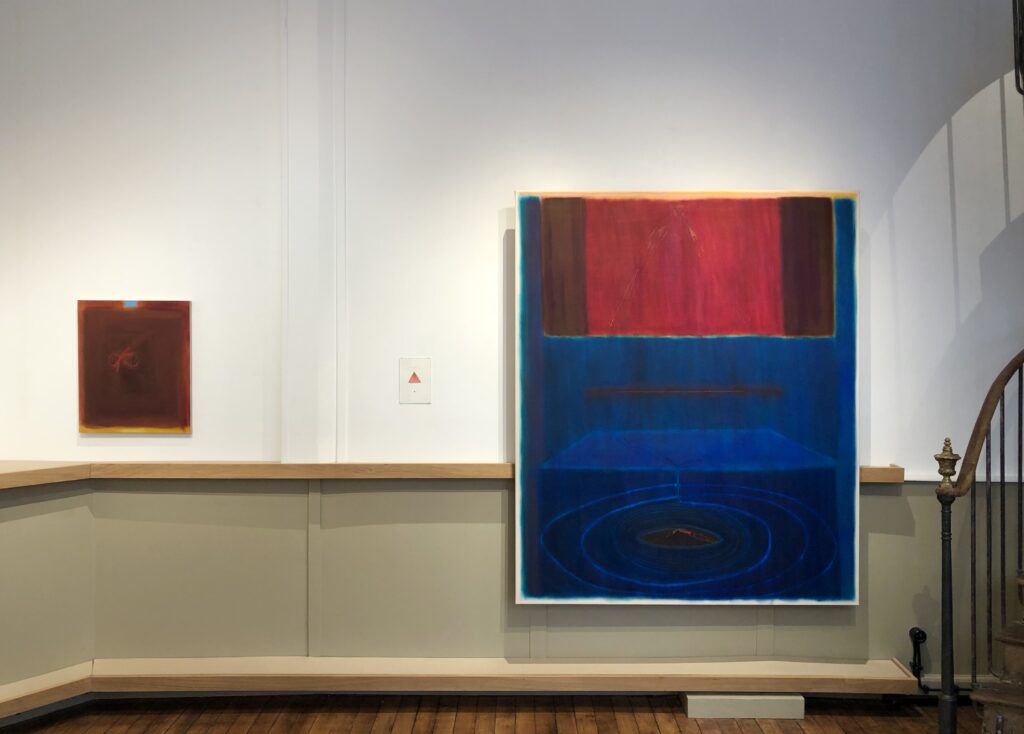
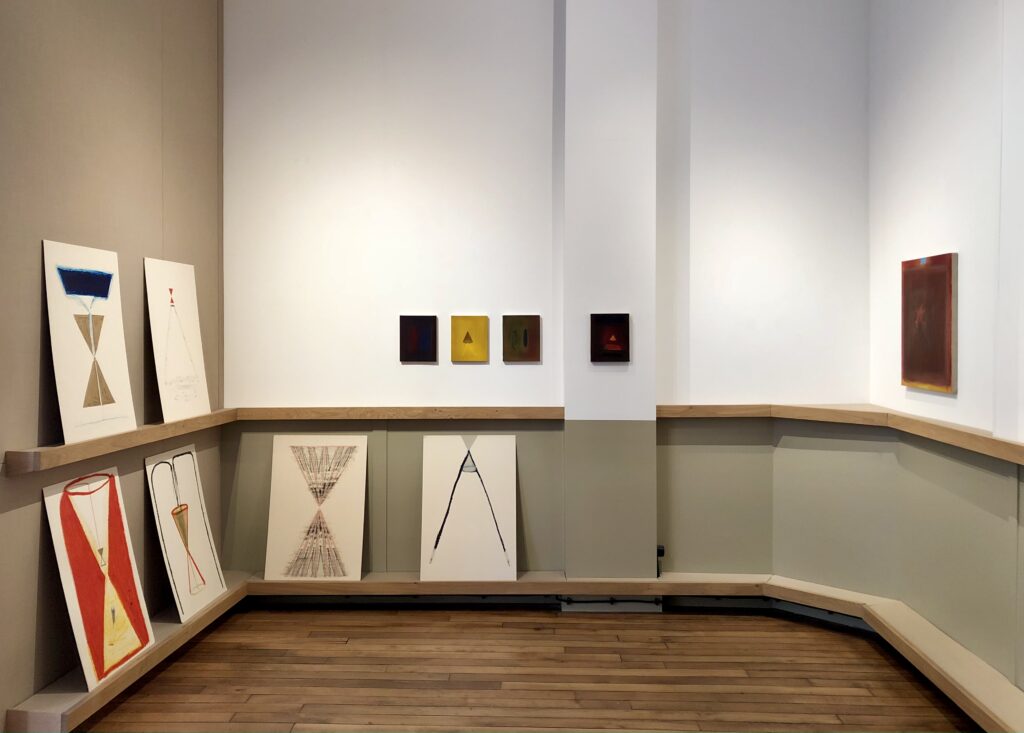
“Painting has always been a place for me to engage with this question I have of how separate I am from the world around me. Where do I begin? Where do I end? In space? In time?” Rather than offering definitive answers, Amorelle Jacox’s (b. 1994) paintings multiply angles of approach to probe these fundamental questions more deeply. The artist favors a metaphorical treatment that owes much to poetry and its relationship to the ineffable.
Situated at the crossroads of abstraction and figuration, her poetic language draws as much from color field painting as from transcendentalism, symbolism, or surrealism. Areas of colors, gradients, and successive layers of color compose dense and deep spaces in which Jacox suspends obsessive forms — ellipses, triangles, hourglasses, tables, black holes, levitating bodies. These are not symbols in the strict sense, but open, intuitive metaphors, imbued with personal charge. “Simple shapes have a huge influence on the ways in which the work changes. I am not entirely sure how new forms come into the work, often they come in quietly through a drawing or a small painting; and when they catch I become a bit obsessed with painting the form over and over, as well as finding it involved in my day-to-day life.”
These figurative and spatial elements shift gradually, as the artist discovers new facets of her research. She describes the evolution of her work between 2022 and 2025, during which the works gathered in They turn into days were created: “it seems that over the past few years the work has moved from pairing the interior body with the external world, to placing the even more miniscule elements such as particles/dust (cells) with broader conceptions of space/time and where the limits of quantification butt up against our lived experience of them. With this figurative shift in the work, a spatial shift also arrived. Where the space was pure-atmospheric color fields before, there are now margins and nooks and edges. All forms still exist on the same plane, the only perspectival quality in the work is that of time – the build up of very thin layers of paint that reveal themselves in the edges (I think of these as the trenches of time).”
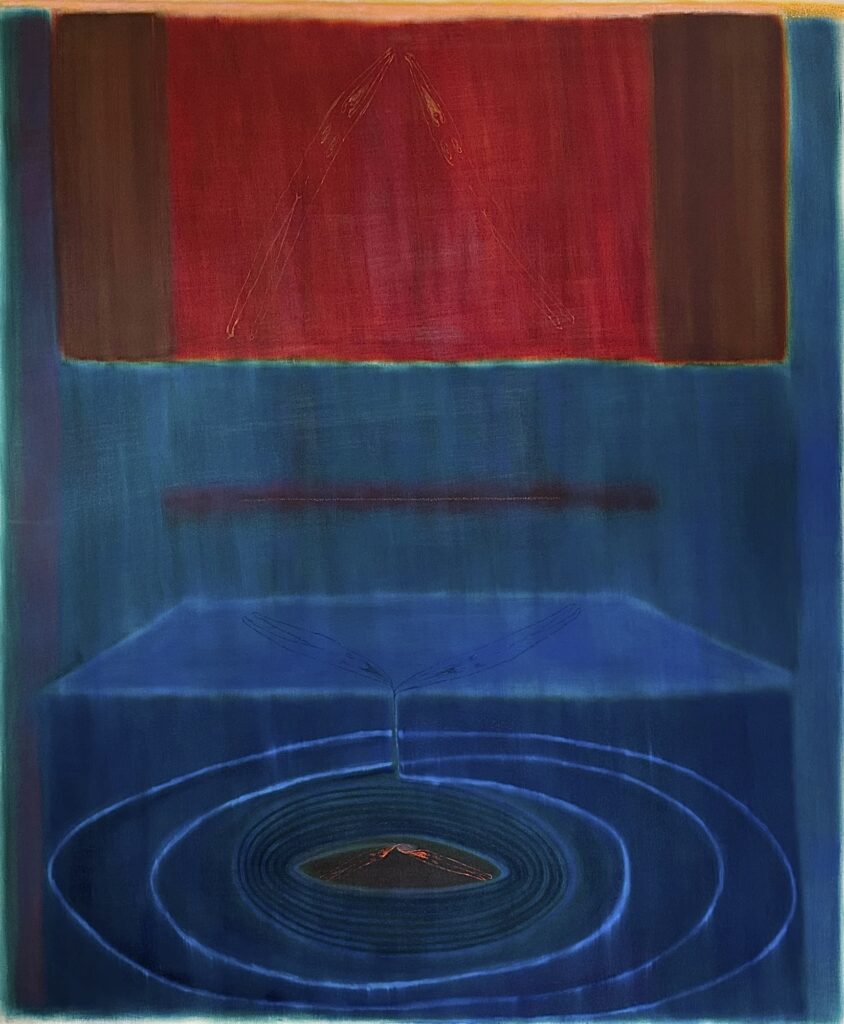
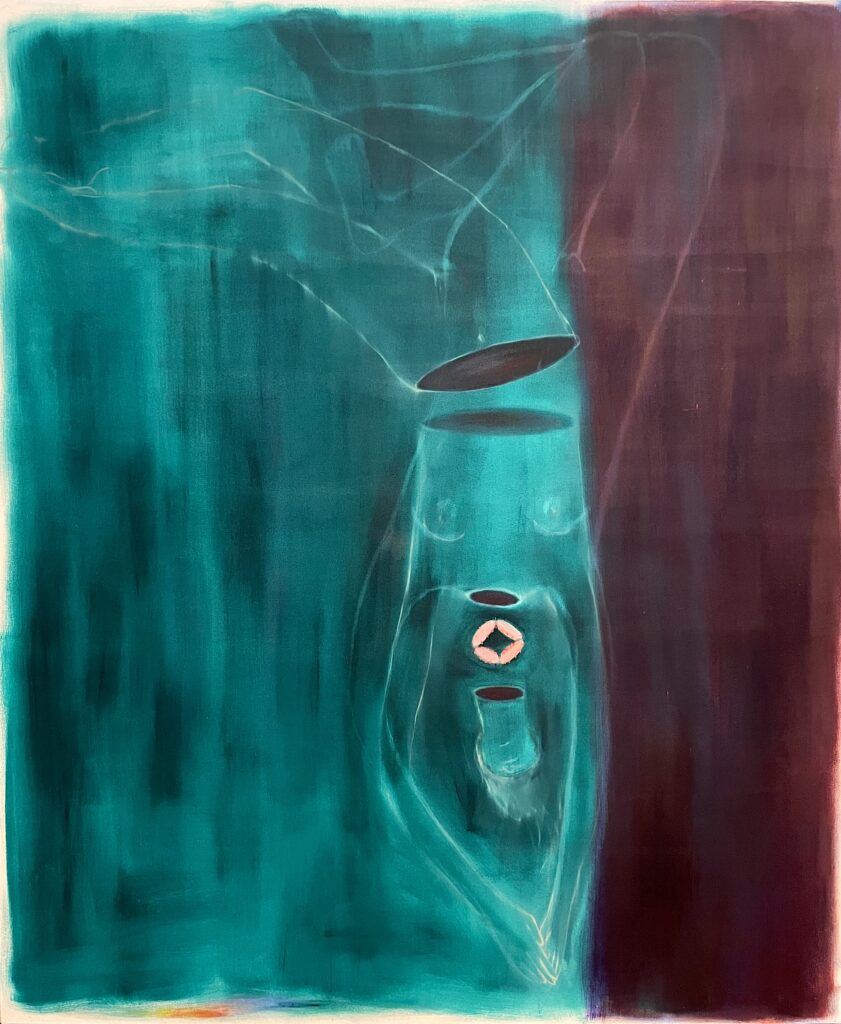
Abraham & Wolff is pleased to present Amorelle Jacox’s work in collaboration with Management, New York. They turn into days brings together canvases and works on paper created in New York in 2022 and 2025, and in 2025 in Alvémont, Normandy, at the artists’ residency of Galerie Jocelyn Wolff.
Jacox holds an MFA from Hunter College (2022). Recent exhibitions include Light Catcher, Time Keeper at 12.26, Los Angeles (2025), Gravity was an entity at Management, New York (2024), An Infinite Sunder at Lauren Powell Projects, Los Angeles, CA (2023), and Two projections of time, Baseltor Kiosk, Solothurn, Switzerland (2022). She recently completed a residency with Wolf Hill Arts, Chappaqua, NY (2023). Jacox was a recipient of the Marjorie Strider Foundation Grant (2022). Her works and writing have been published in Art Maze (2023) and Yale School of Divinity’s LETTERS journal (2019).
Lena Hilton & Elodie Seguin, La Figure Peinturative
05.09 — 11.10.2025
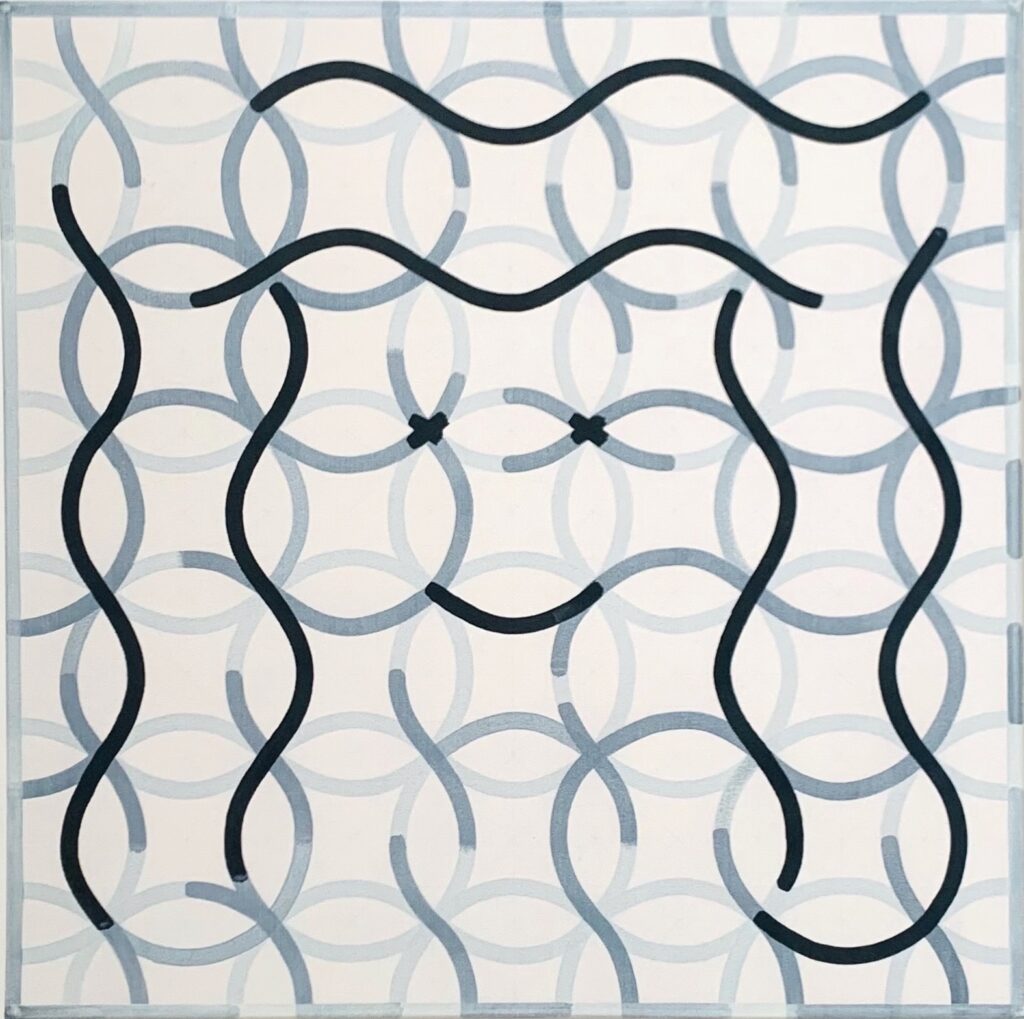
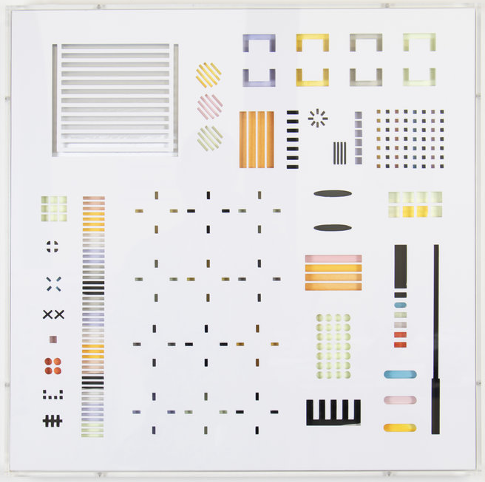
For this first exhibition of the season, Abraham & Wolff is pleased to bring together Lena Hilton and Elodie Seguin, two artists with distinct practices yet united by a shared conception of painting. From one to the other, we find a concern for economy, a precise use of color, and the rigor of a sensitive practice built over time. For both, painting is a fertile reduction, made of potentialities and intentions addressed to the viewer.
Lena Hilton paints canvases. Her approach is analytical and methodical. Each series follows rules, unfolding from frameworks and grids that invite multiple variations. From these constraints, rooted in elementary geometry and close to a decorative language, emerge surfaces of emancipation and freedom. They offer a gaze that remains open to possibilities.
Elodie Seguin, on the other hand, shifts painting beyond the canvas, investing and distributing it within real space. “In all her works, she explores the boundaries between drawing, painting, and sculpture (…) seeking the exact moment of undecidability, of perfect ambivalence.” Paradoxes, absence, the interplay of light and color, transparency, subtraction, doubling… all intersect in her research. Her installations and wall paintings integrate the dimensions and specificities of each site. They blend with volumes and surfaces, the real space becoming as much the interpretative framework of the work as it is interpreted by it. In its contraction, painting must “create place.”
If one privileges the canvas while the other surpasses it, their explorations converge toward a process of abstraction that cannot be defined merely by the absence of representation. The very title of the exhibition recalls this shared concern: through a play of inversion, “La figure peinturative” renders painting active and designates it as the subject of the figure. To open meaning, to implicate the real, to question painting—its means, its language, its history. A reminder that painting never begins from nothing, that it must also bring forth what is not yet, what time will once again conceal.
And in deciphering the statement they composed for this exhibition, one can find:
“… what is happening here? …
… we are looking …
… the vanished painting …
Lena Hilton’s work has been shown in France and abroad, in various exhibitions (All Over, Galerie des Galeries, Paris, 2016; Single Grid – Trame Simple, Wilde Gallery, Geneva, 2023), as well as at contemporary art fairs in Madrid, Turin, and Geneva. She was the invited artist for Windows on Talent at Galeries Lafayette in 2016, and in 2024 she created monumental decorative paintings for Hermès in the United States. She is a recipient of the Prix Novembre in Vitry (2015).
Elodie Seguin’s work has been exhibited in numerous institutions such as MACBA in Buenos Aires, the PEAC Museum in Freiburg, MUDAM Luxembourg, the French Cultural Center in Milan, Fondation Ricard, as well as in the STATEMENT section at Art Basel and the Frame section at Frieze London.
Jochen Gerz, Revolut…
06.06 — 24.07.2025
A conceptual artist of German origin, Jochen Gerz (born in 1940) has built his work around the themes of separation and memory. After studying philology, sinology, and prehistory, Gerz began a brief career as a writer, which he ended after concluding that modern poetry was a dead end. A self-taught artist, he then turned to the visual arts to develop a radical critique of language and image in a society dominated by mass media. Since 1966, when he settled in Paris, Gerz has questioned modern communication and its channels through public performances, installations, videos, editions, and photographs.
Started in the early 1970s and continued over a decade, the Photo-Texts series takes the form of juxtaposed images whose subjects appear unremarkable at first glance: a woman walking a dog by a river, a landscape seen through a car windshield, a tree-lined path in a park, and so on. Each black-and-white photograph is taken in the same place, from the same angle, a few seconds apart (or following longer ellipses), capturing tiny changes: the passage of time rather than an event. A text accompanies the images, like the voice-over of a film. It does not describe or caption but instead invents a poetic fiction, a story. Confronted with the apparent absence of a message, the viewer is invited to reconsider their relationship with photography and text, to question their expectations of a work of art: “Perhaps that is why image and text appear simultaneously in my work, explains the artist. Their impossible addition creates, under the pretense of clarity, a dismissal between the gaze-as-hunter and its object on the wall. For once, the desire to understand or to recognize remains unanswered: the gaze sees itself.” (Patrick Le Nouëne, “Interview with Jochen Gerz,” in Gerz, Works on Photographic Paper 1983 –86).
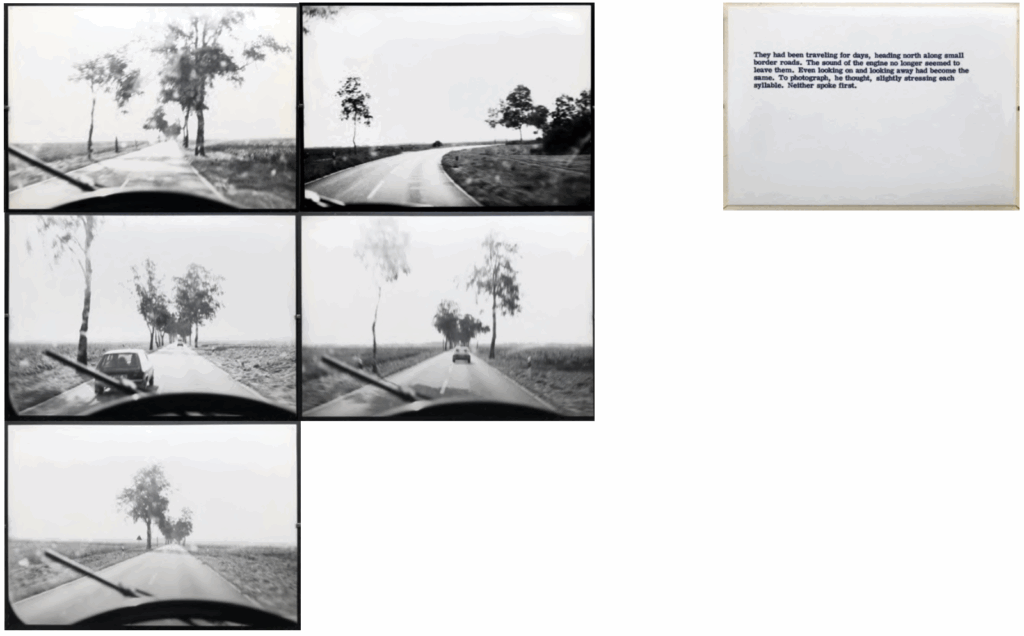
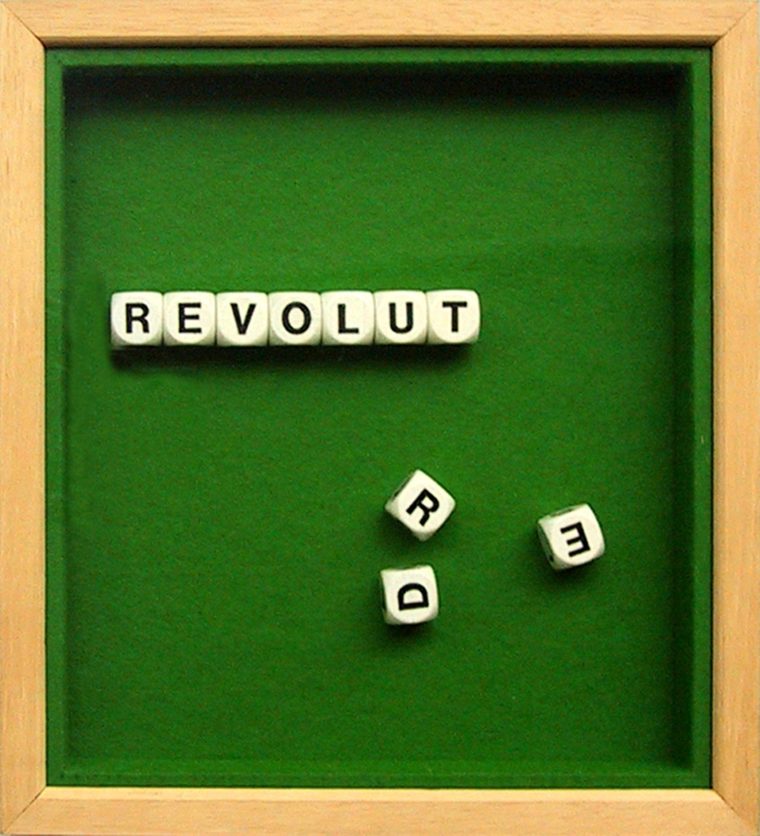
The editions he produced in parallel extend the reflections of the Photo-Texts, particularly emphasizing the themes of time and memory. Gerz also plays with the materiality of language and its capacity to signify, in an approach directly inherited from the visual and concrete poetry he practiced early in his career. In the edition titled Revolut… (1971; 1990), for instance, he dismantles the final letters of the word “revolution,” inscribed on small wooden dice, to evoke its meaning visually.
By the late 1980s, Gerz increasingly turned toward installing monumental works in public space. His “anti-monuments,” as he calls them, invoke collective memory and collective responsibility in the face of history through installations that subvert the very idea of commemoration. In 1990, he and his students secretly removed paving stones from the square in front of the Saarbrücken castle — formerly Gestapo headquarters, now the seat of the regional parliament. Beneath each stone, Gerz had the name of a German Jewish cemetery engraved before replacing it with the inscription symbolically turned downward. In total, 2,146 paving stones were marked and reinserted, forming The Invisible Monument.
Jochen Gerz participated in Documenta 6 and 8 and exhibited in the German Pavilion at the 37th Venice Biennale in 1976 (alongside Joseph Beuys and Reiner Ruthenbeck). His work has been featured in numerous solo and group exhibitions, as well as major retrospectives in German, European, and North American museums — including a major exhibition at the Centre Pompidou in 2002. He is represented in more than a hundred international public collections, including the Art Gallery of Ontario, Toronto; Hamburger Bahnhof – Museum für Gegenwart, Berlin; Neue Nationalgalerie, Berlin; San Francisco Museum of Modern Art; The Banff Centre, Walter Phillips Gallery, Banff; Musée d’Art Moderne de la Ville de Paris; and the Musée National d’Art Moderne, Centre Georges Pompidou, Paris.
Revolut… is his first gallery exhibition since he decided to devote himself to public commissions and outdoor projects. It brings together a significant selection of Photo-Texts and editions spanning the period from 1968 to 1990, thanks to the generous support of a family of patrons and passionate collectors.
Edward Thomasson — Doctor Theatre
Curated by Dorothea Jendricke
04.26 — 05.31.2025
Abraham & Wolff is pleased to present Doctor Theatre, the first solo exhibition in France by London-based artist Edward Thomasson.
Born in 1985 in Stoke-on-Trent, UK, Thomasson’s work spans painting, drawing, video, writing, and performance. His practice is rooted in the poetics of group behaviour, the fragile architecture of interpersonal care and the challenges of intimacy and sexuality. Often working collaboratively with trained or untrained performers, with friends and composers, his performances involve singing, acting and choreography to explore how people gather around desire and longing, and attempt to support one another.
Thomasson’s works on paper carry the distinctive energy of his live performances. With their choreographed liveliness and dynamic gestures, they offer moments of introspection and a strange joy. In Doctor Theatre, a new series of watercolours continues his investigation into the negotiations of everyday encounters.
The exhibition takes its title from theatrical folklore. Doctor Theatre is the name given to the phenomenon whereby a performer, feeling ill, goes on stage to perform regardless, and makes a miraculous recovery just for the time they are onstage.
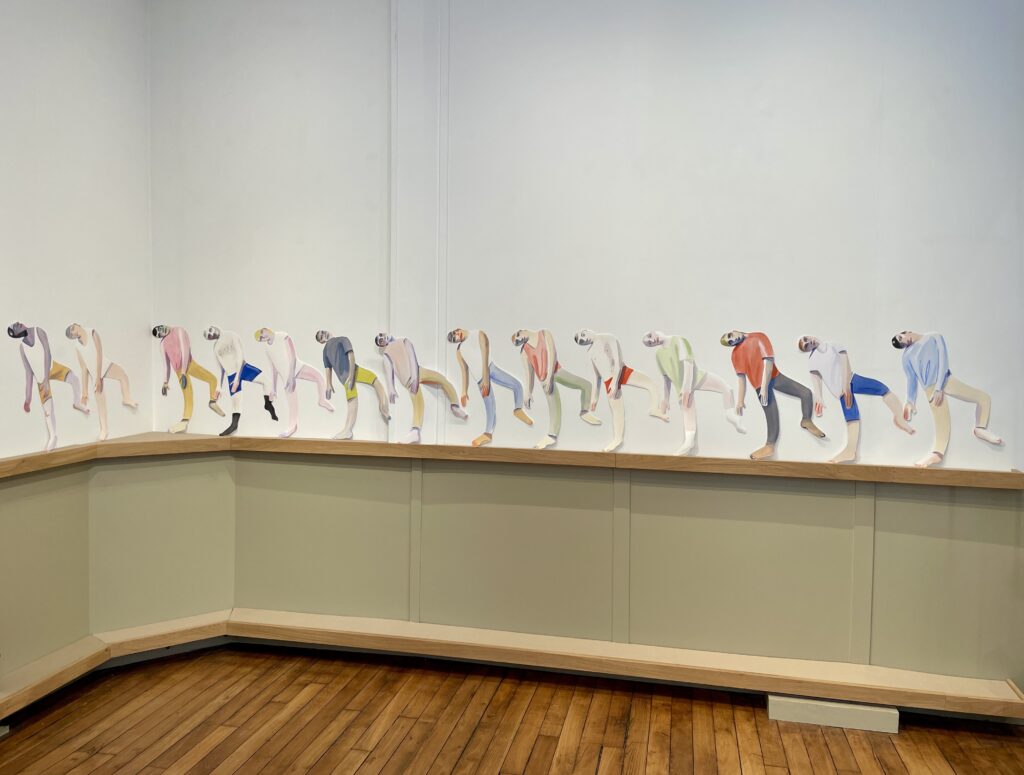
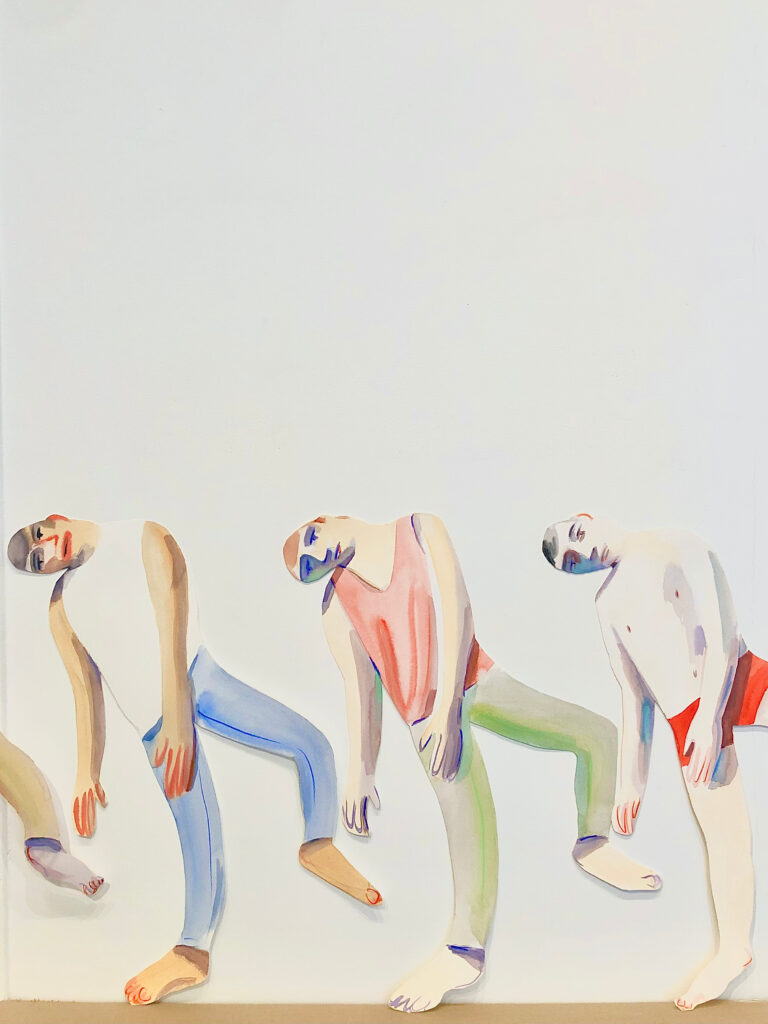
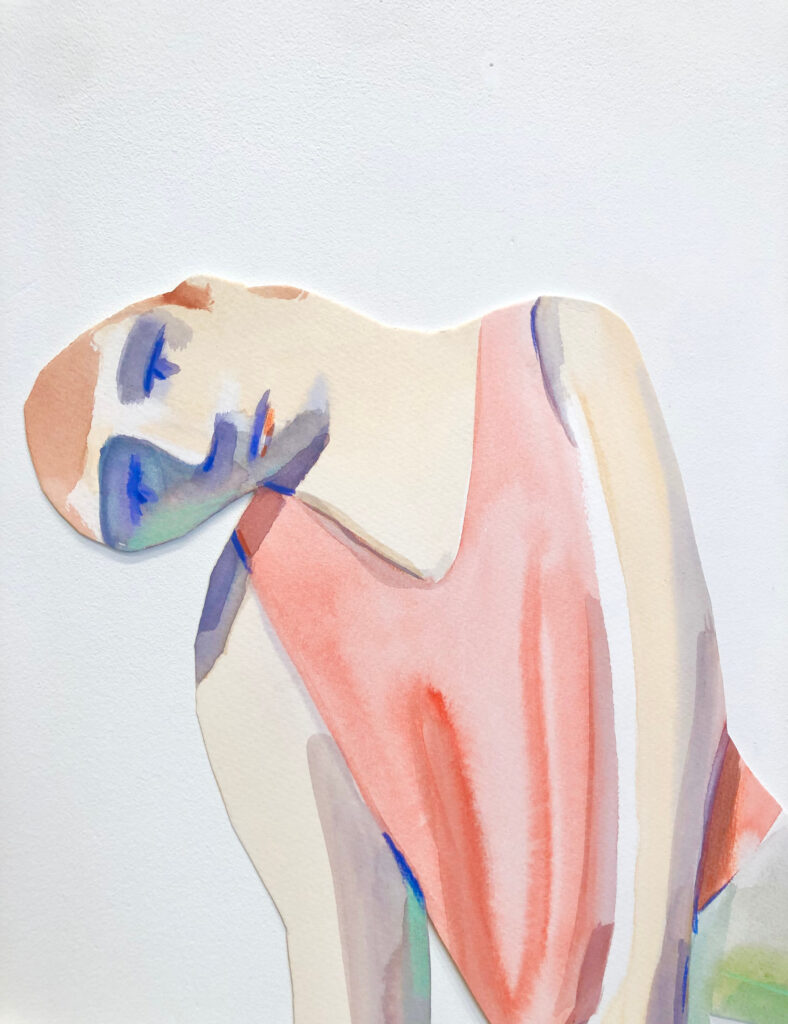
Central to the show is a chorus-line of figures arranged along the perimeter shelves of the gallery. Sharing the exhibition’s title, these characters extend Thomasson’s ongoing reflections on repetition as both structure and metaphor. In a new departure, attention shifts to the individual moment of transformation: each figure appears suspended mid-gesture, poised between descent and elevation. Their awkward, stylised poses are taken directly from El Pelele (1791–92) by Francisco de Goya. The painting is also known as The Straw Manikin, an early Goya painting with a soft palette and celebratory surface that veils a quietly ominous undercurrent. Thomasson channels this duality in his own figures, which are simultaneously animated and immobilised, comic and tragic, suspended but seemingly on the verge of collapse. Still, they retain a distinct gracefulness in their suspension.
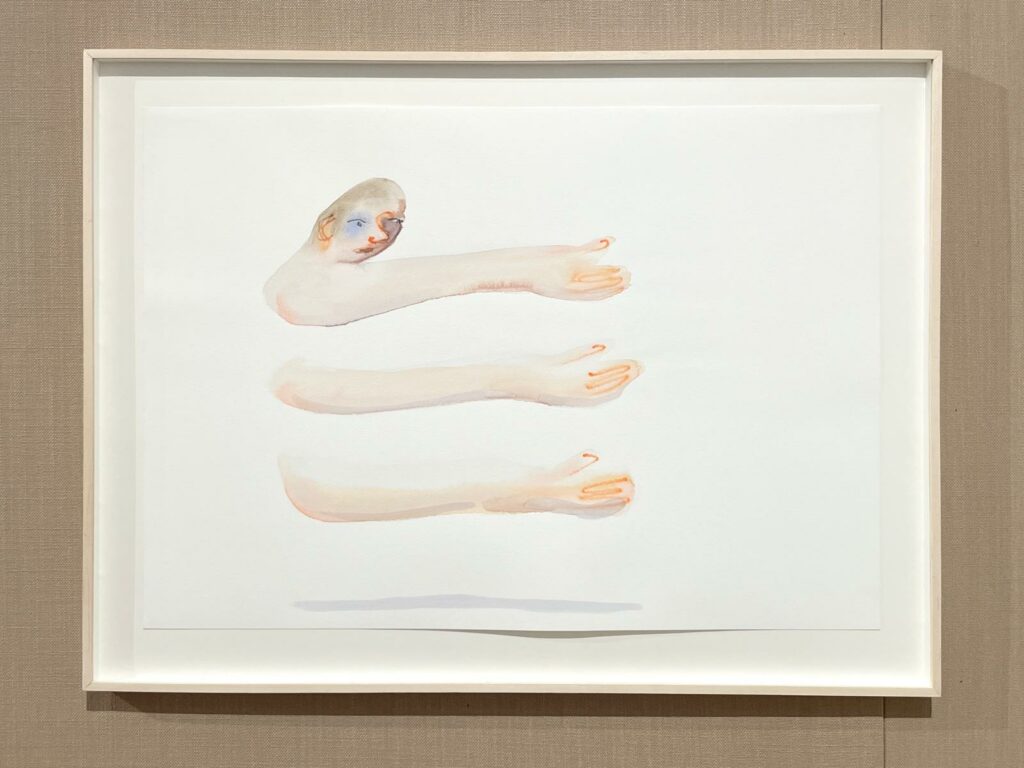
Alongside the Doctor Theatre series, Thomasson presents two new works on paper that expand his visual language around gesture, emotion, and the social stage. No one is ever as fluent in sex as they are in your head, a large-scale work, describes a feeling of stuckness or impasse, while also bridging the public exterior of the street with the introspective space of the gallery. In It’s already happening, a framed watercolour, he continues his exploration of emotional choreography and spatial intimacy.
Doctor Theatre follows several recent projects. In April 2025, Thomasson premiered The Whole Routine at London Performance Studios, a musical performance created with composer Charlotte Harding and songwriter Robbie Ellen. Developed over several years in workshops, songs and movement are used to reflect on the bodily language of coping mechanisms. In 2024, his performance Grace and Harmony was presented at KW Institute for Contemporary Art in Berlin, and Channels V was shown at Lateral in Rome and at Phillida Reid in London. In the latter, a series of pastel cut-out paper figures are suspended on string like a garland, both supported and bound by the same gesture. Thomasson’s 2023 exhibitions Burning Desires and Endless Love introduced large, linen-mounted paper works. These depicted bodies are bending into letterforms, lining up to carry a shared weight, or merging in acts of symbolic penetration with gestures of connection, burden, and mutual dependence.
Dorothea Jendricke, April 2025
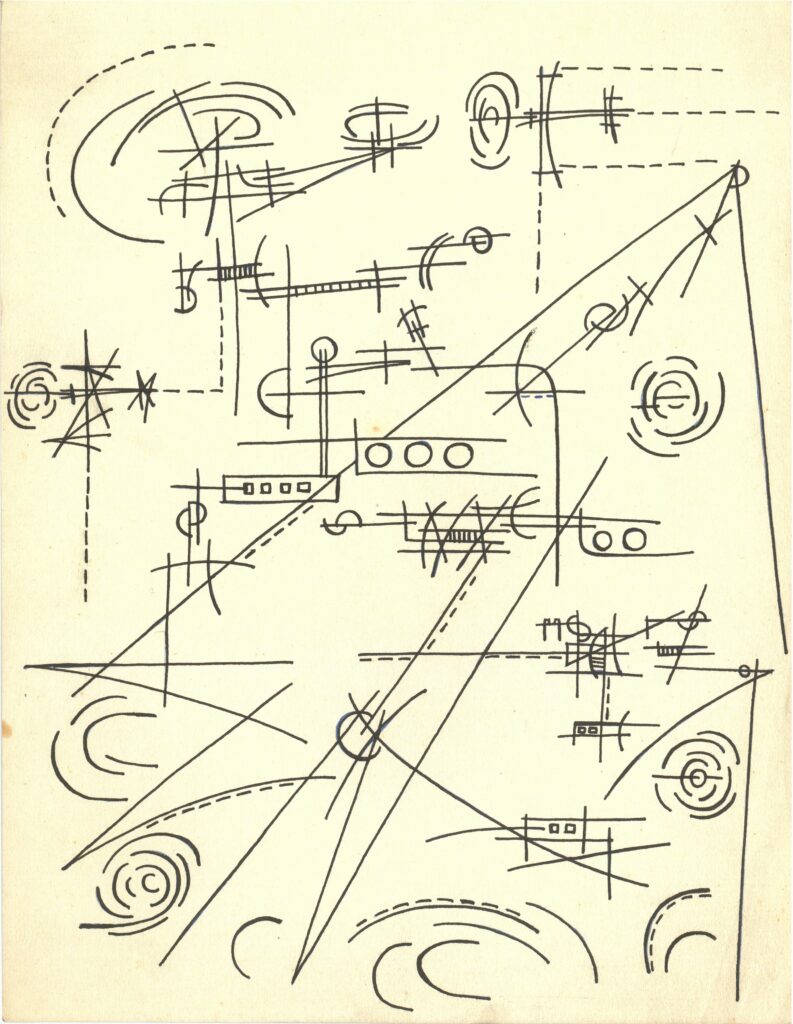
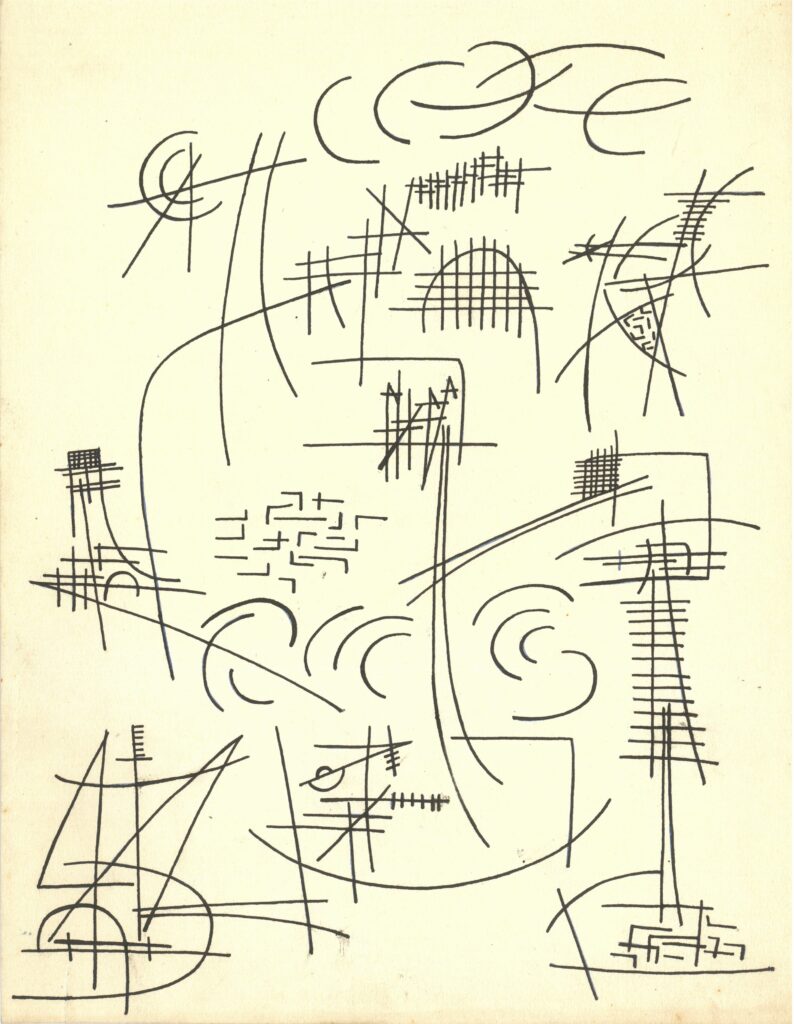
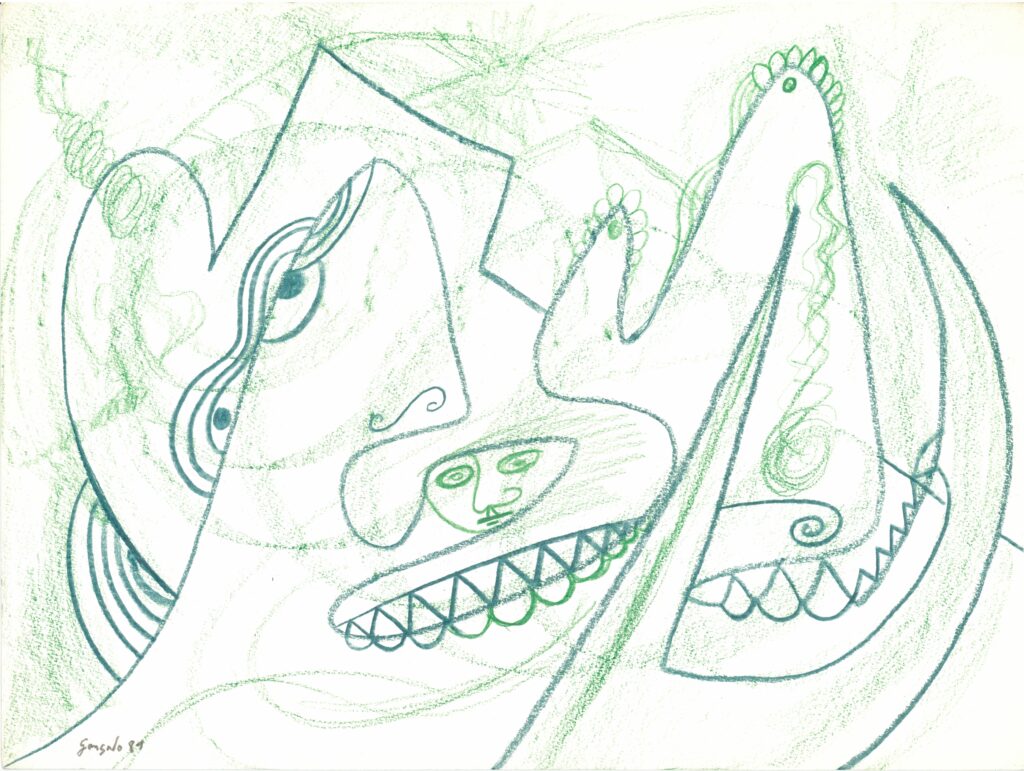
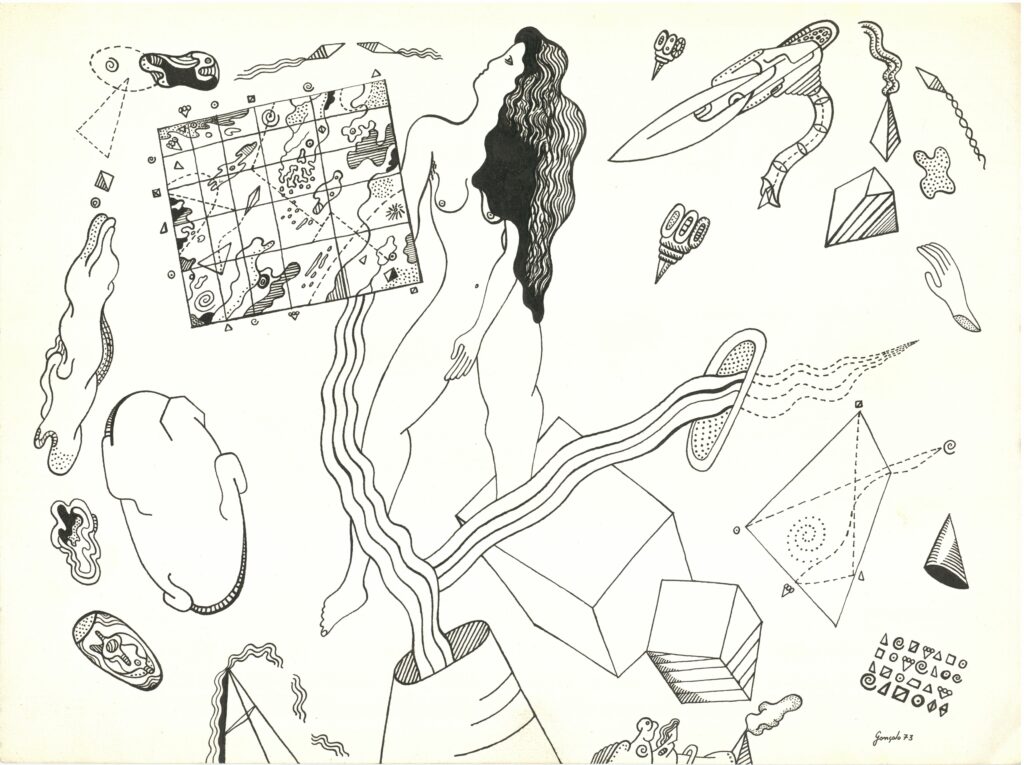
Gonçalo Duarte – Hiéroglyphes modernes
28.03 — 19.04.2025
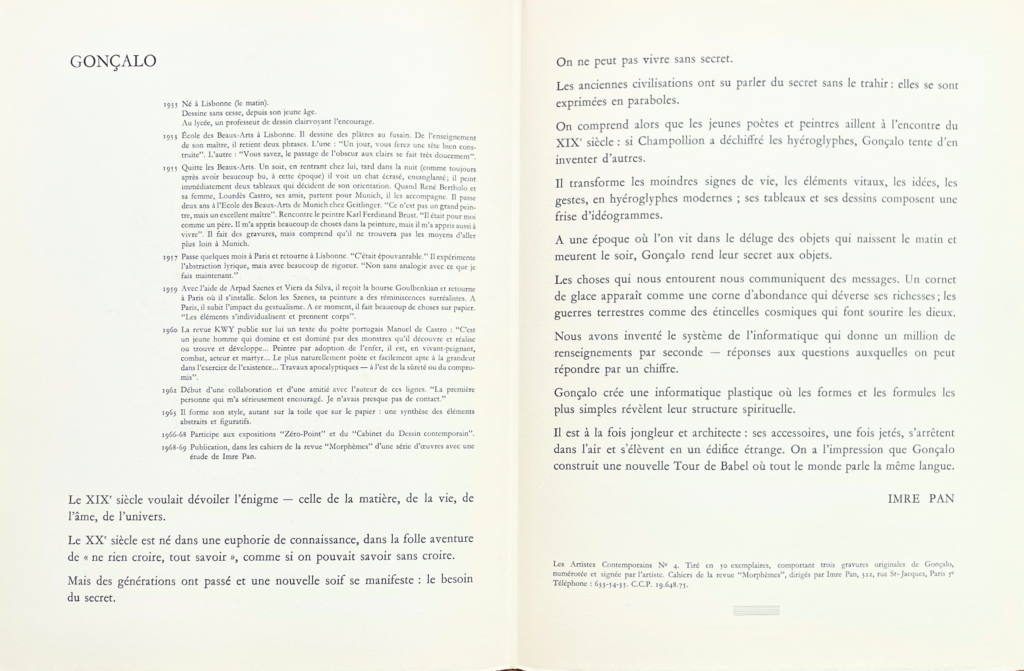
Gonçalo Duarte (1935 – 1986) belongs to that generation of Portuguese artists whose destiny was marked by dictatorship and exile. Like many of his compatriots, he felt an early desire to flee an Iberian Peninsula that was not conducive to the development of new ideas.
After studying at the Beaux-Arts in Lisbon, Duarte left Portugal in 1955 to continue his education in Munich with Lourdes Castro and René Bertholo. Two years later he moved to Paris, where he settled permanently in 1959, thanks to a Gulbenkian scholarship and the support of his friends Arpad Szenes and Maria Helena Vieira da Silva. When he returned to Lisbon briefly to exhibit his work, he confessed to feeling ‘out of place and immersed in an enormous solitude’ (letter to Imre Pán dated 13 April 1964).
In Paris, Duarte became a central member of the KWY group, to which Abraham & Wolff devoted an exhibition in October 2024 (Autour de KWY: 1958 – 1964, curated by Anne Bonnin). Initiated by Lourdes Castro and René Bertholo, KWY brought together young artists in exile: the Portuguese António Costa Pinheiro, José Escada, João Vieira and Gonçalo Duarte, the Bulgarian Christo and the German Jan Voss. Together they run the magazine of the same name, a composite art object made up of original serigraphs, photomontages, collages, postcards, poems and theoretical texts. Duarte’s contributions take the form of silkscreens, reflecting his interest in informal and lyrical abstraction.
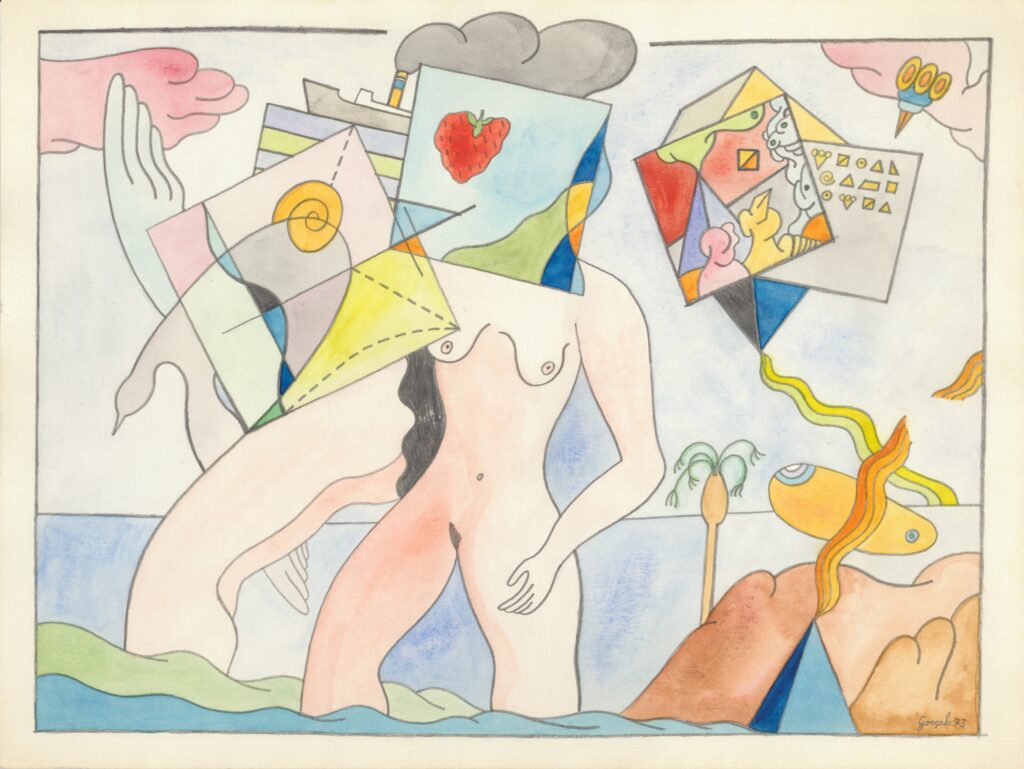
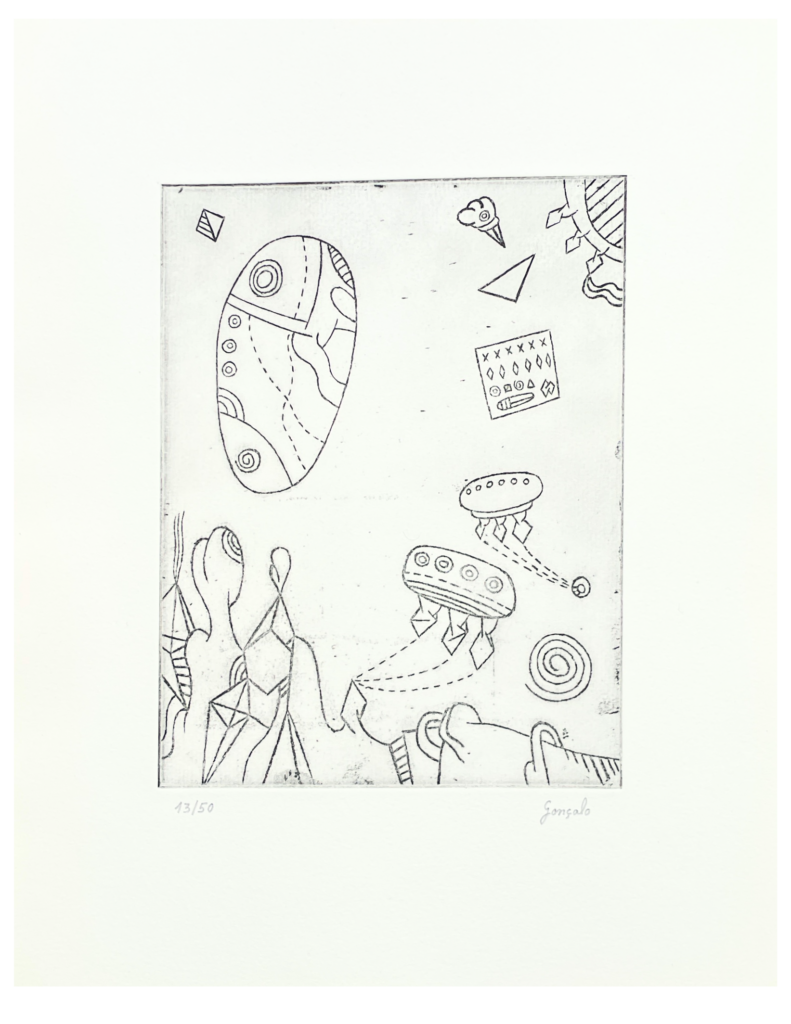
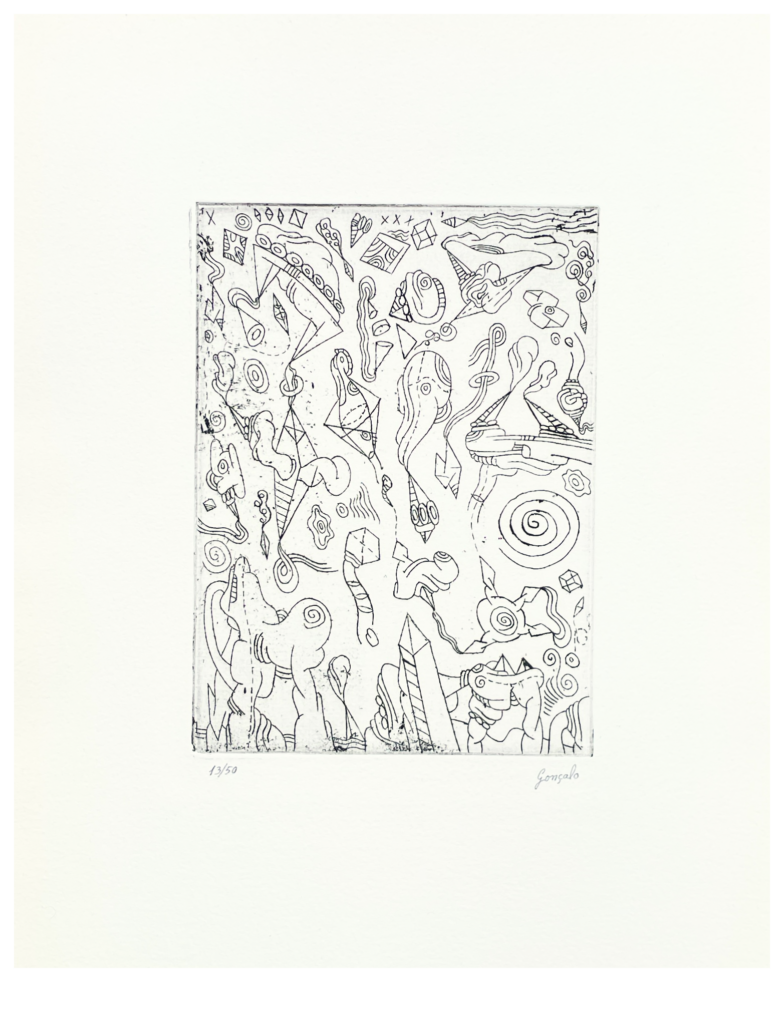
In 1963, the artist started an important series of figurative canvases and drawings inspired by Surrealism. In them, he used a repertoire of obsessive motifs composed of snakes, eggs, smoking chimneys, changing bodies and female figures, cubes and pyramids, spaceships and ships. All these elements and symbols collide to form rebus whose solution eludes us, as in a dream. As the artist himself puts it: ‘Painting or drawing is to give concrete form, step by step, to a dream’. These reveries led the Hungarian critic and intellectual Imre Pán, whose interest in KWY manifested itself in several editions dedicated to the members of the group, to say that Duarte ‘transforms the smallest signs of life, vital elements, ideas and gestures into modern hieroglyphs. […] He is both juggler and architect: his props, once thrown, stop in mid-air and rise into a strange edifice. You get the impression that Gonçalo is building a new Tower of Babel where everyone speaks the same language” (Imre Pán, Morphèmes, Paris, 1968).
Abraham & Wolff is pleased to be exhibiting a previously unseen group of drawings by Gonçalo Duarte covering the period from 1961 to 1981. Hyéroglyphes modernes provides an insight into the artist’s development from abstraction to these highly personal dreamlike compositions.
We would like to express our warmest thanks to Garance Duarte for opening up her father’s archives to us, and to Sophie Pán for her generous support.
Laura Lamiel – L’Herbier
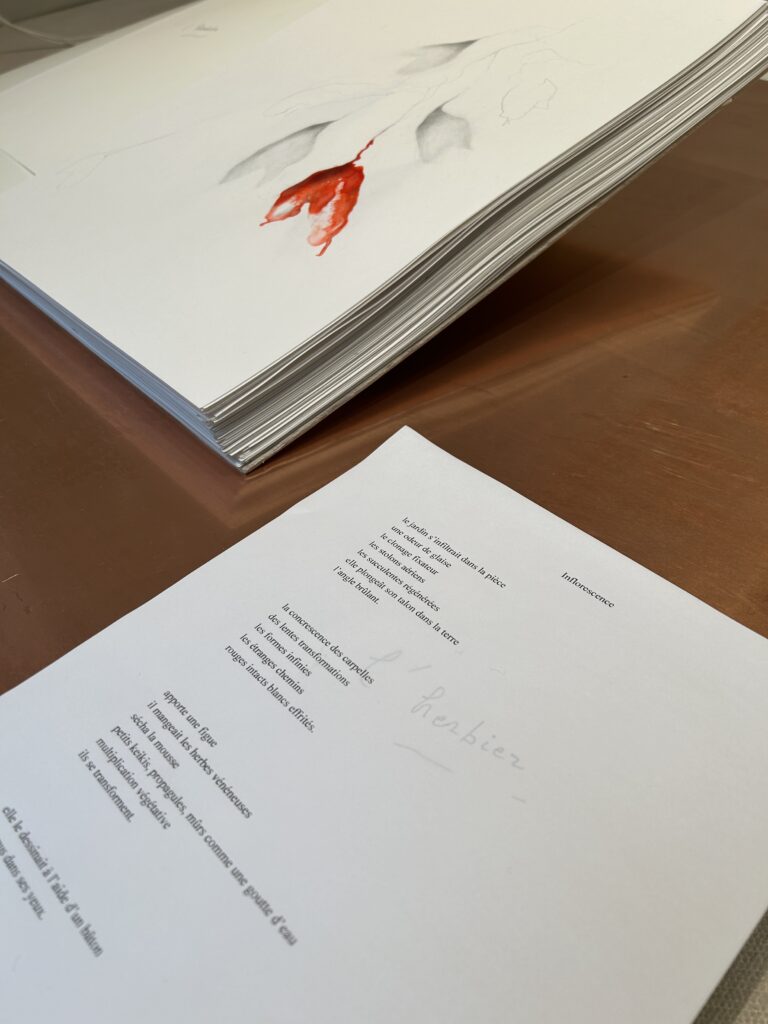
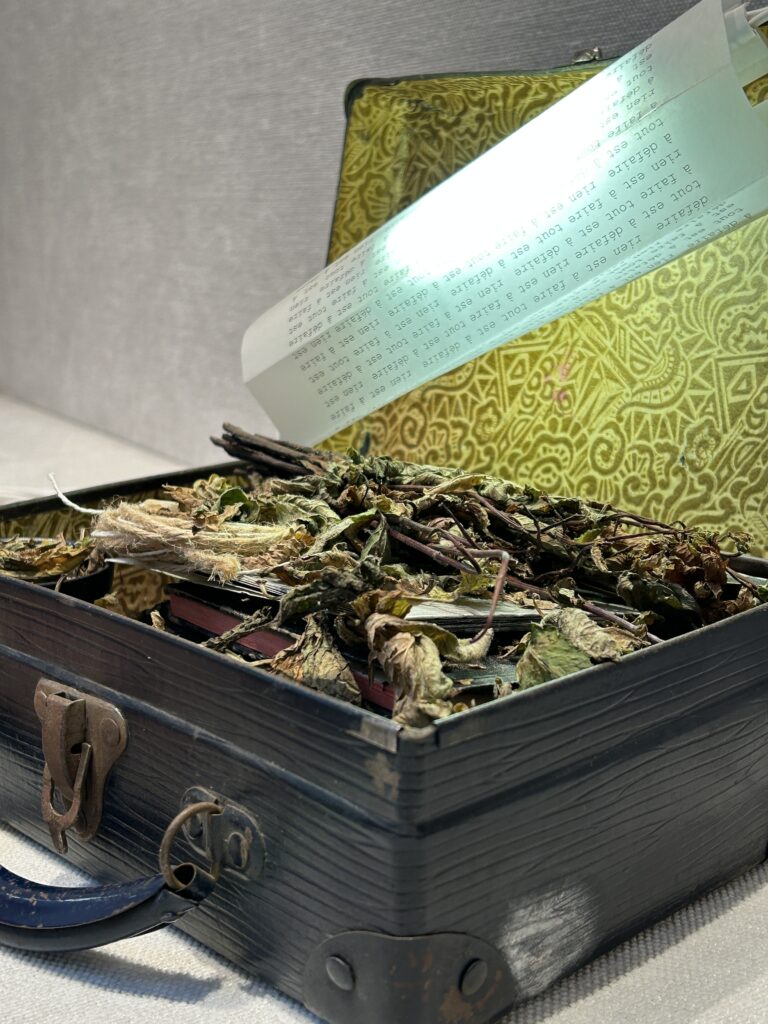
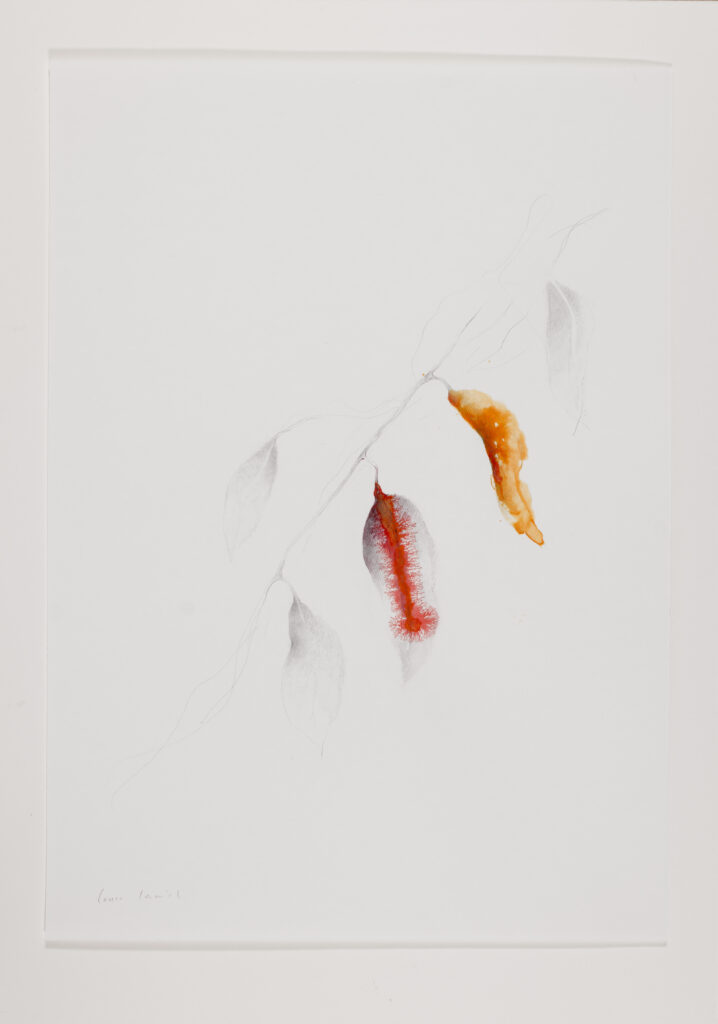
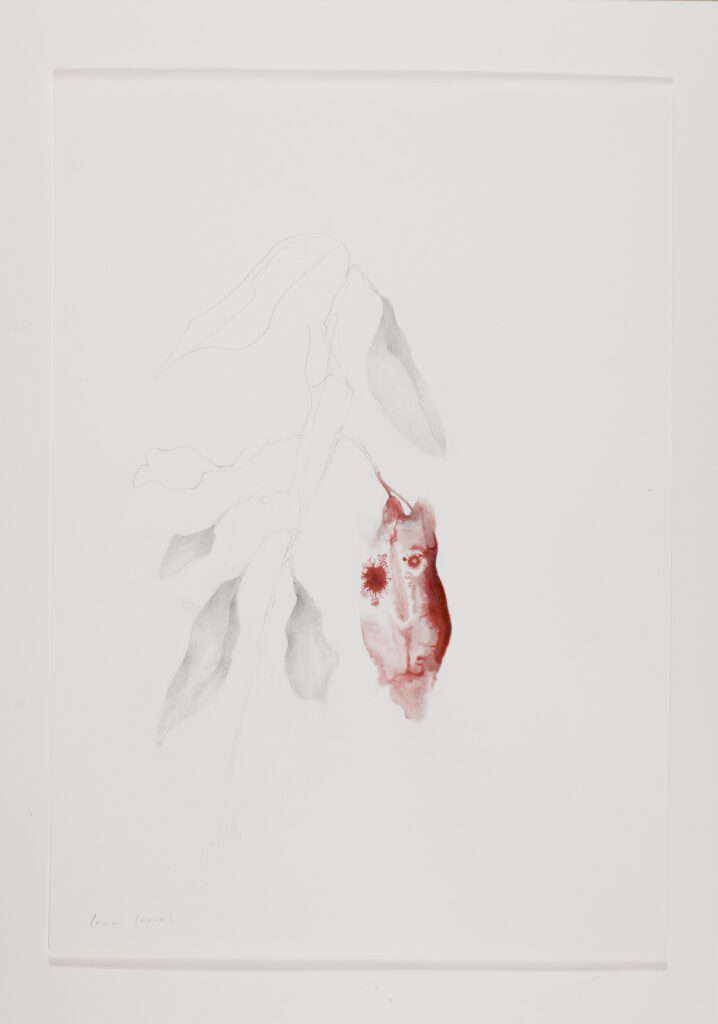
Abraham & Wolff is pleased to present a new exhibition by Laura Lamiel. The artist displays an installation specially designed to house her latest series of drawings, L’Herbier. It is based on a matrix of one hundred sheets, from which unframed and framed drawings seem to emerge, along with a poem written by the artist herself. These drawings extend certain themes explored in the Territoires intimes series, such as the root and the rhizome. Inscribed in a subversive history of herbarium practice, they represent an imaginary flora of hybrid and suggestive forms, whose inflorescences unfold following the movements of the ink.
A major artist on the contemporary French scene, Laura Lamiel has been exhibited at La Verrière (Brussels, 2015), the CRAC Occitanie (Sète, 2019) and the Palais de Tokyo (Paris, 2023). She was awarded the AWARE honorary prize in 2022.
We warmly thank Galerie Marcelle Alix (Paris) for its close collaboration.
Stone Lights with William Anastasi, Irene Kopelman, Laura Lamiel, Camille Vivier, Alfredo Barbini, Roberto and Glauco Gresleri, Giuliano Cesari
17.01 – 08.02.2025
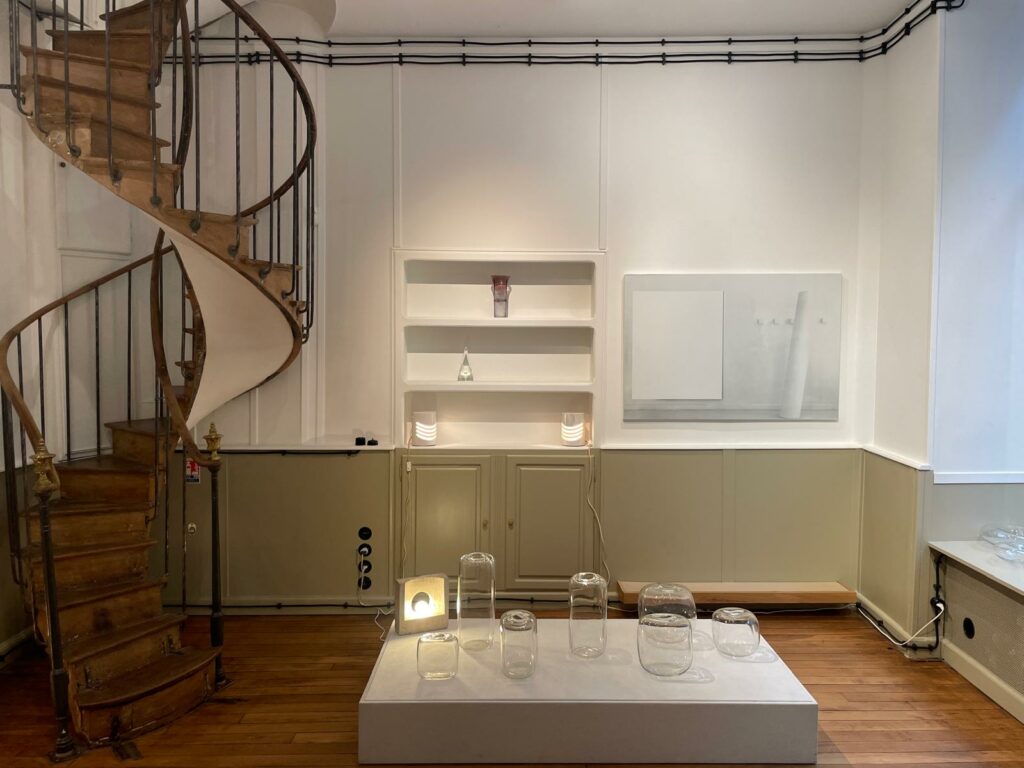
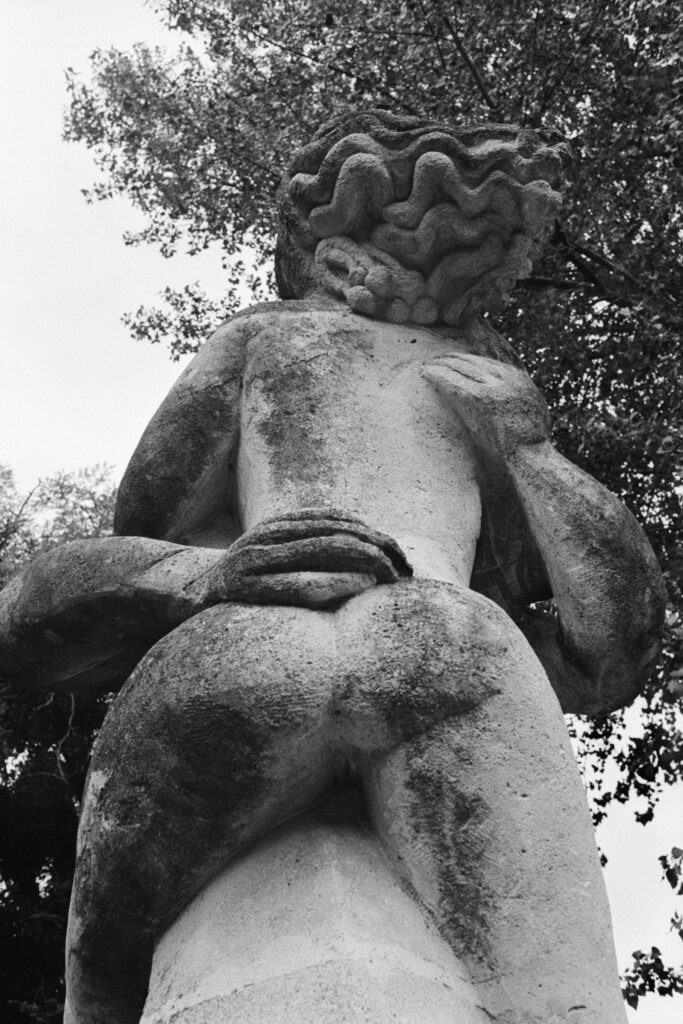
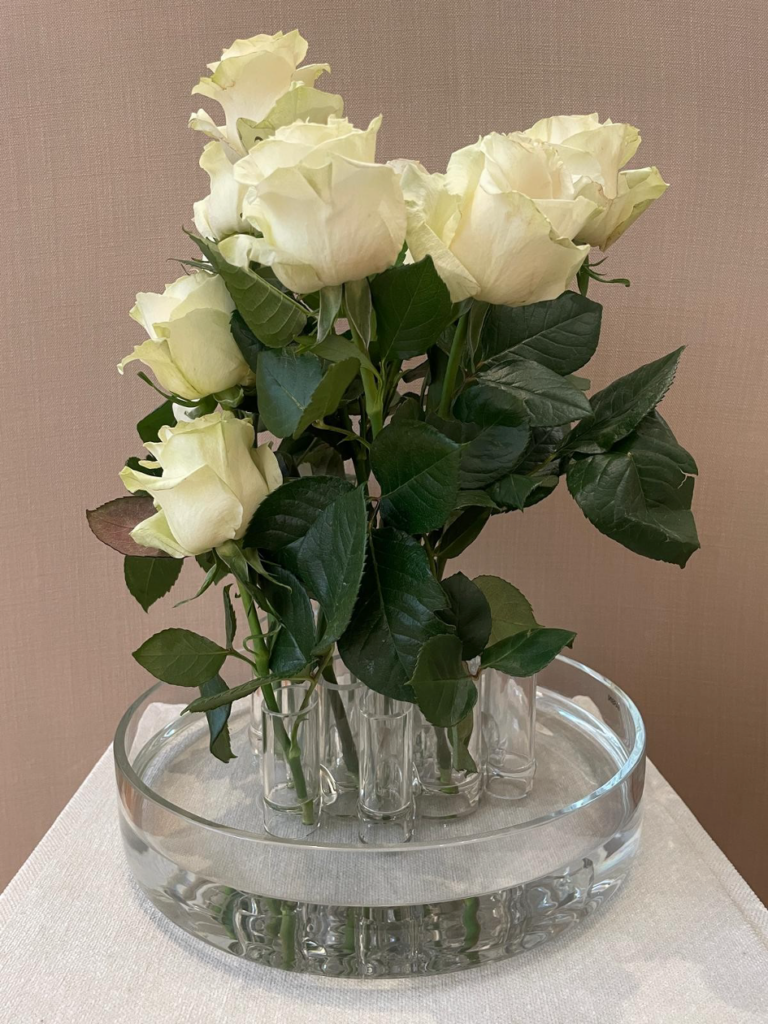
For this new exhibition, Abraham & Wolff is delighted to present works by Laura Lamiel, Irene Kopelman, Camille Vivier and William Anastasi, as well as a selection of design pieces by Alfredo Barbini, Giulinano Cesari and Roberto and Glauco Gresleri.
Our warmest thanks to Camille Vivier and Marcelle Alix, Paris, and Compasso, Milan, galleries for their generous collaboration !
Cabinet Cabinet Curiosity Curiosity
Michele Chu, Chan Ting, Sasaoka Yuriko, Magdalen Wong, Xi Jiu, Zheng Mahler
Curated by PHD Group, Hong Kong
6 Dec – 11 Jan
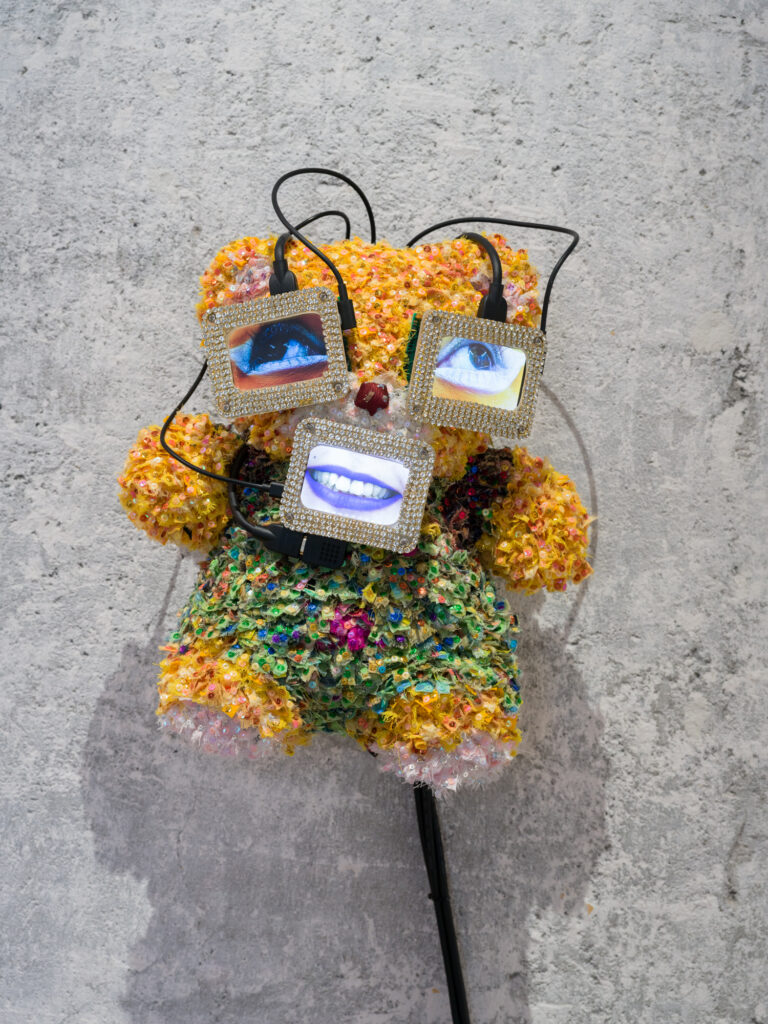
The curiosity cabinet, or kunstkammer, has for centuries enthralled audiences with its arrays of wonders and oddities. Originating as privately kept miniature rooms or cupboards, the cabinet emphasized the abnormal, showcasing objects considered foreign to Occident intellectuals, and selected by wealthy royals, scholars, or merchants. This Orientalist history—and the elite few who decided what went into them—still dictates much of how we approach object and display today, with curiosity cabinets now existing in the public sphere as institutions and museum spaces.
But what does it mean to be curious about an object from another place, dislocated from its context? How can the gaze of wonder confront and challenge the gaze of exoticisation and othering? Can curiosity be removed from concepts of ownership and possession? These questions are foundational to “Cabinet Cabinet Curiosity Curiosity,” a group exhibition curated by Hong Kong-based gallery PHD Group and hosted at Abraham & Wolff in Paris.
To name something once is to define it; to name it twice invokes a soft confusion, similar to when one repeats a word too many times, detaching it from meaning. The abstracted doubling in the title notes the experimental links between the artworks, and also playfully hints at the collaborative nature of the two galleries performing in tandem—one playing the host, presenting a literal cabinet that hints at its past as an antique drawing room, and the other playing guest, providing its curious contents.
The artist duo Zheng Mahler presents abalone-encrusted porcelain pieces from their “A Season in Shell” project, in which they trace the abalone’s trade route from Africa to Hong Kong via Switzerland in a two-fold attempt to understand the mechanical workings of our sociopolitical exchange culture. Sasaoka Yuriko, from Japan, asks how we might be implicated in the capitalist labor of animals with a small singing bear that asks, ever so sweetly, to be employed in a work force. Xi Jiu evokes symbolism in paintings out of her Beijing studio. Hong Kong artists Chan Ting and Michele Chu show new works that engage in the relationship between material, form, and the artist’s hand. Magdalen Wong, also from Hong Kong, plays with the taxonomic naming of plants and the mass market, painting in great detail the plastic flowers she collected from various places over the years.
With this wide range of works, “Cabinet Cabinet Curiosity Curiosity” delivers a missive directly air flown from Asia in an attempt to reverse and banish the cabinet’s problematic historical entanglements. Open-ended and fluid, the displays and selections do not express the stiff stereotypes of cabinets of old, but instead asks what it means to be curious today. We are left only with the barest suggestions of its charming form, and an invitation to open it up and take a look.
PHD Group, November 2024
Catherine DeLattre
Shoppers, Broadway Upper West Side, NYC, 1979-80 and other corners
Curated by Cay Sophie Rabinowitz
Oct 30 – Nov 30, 2024
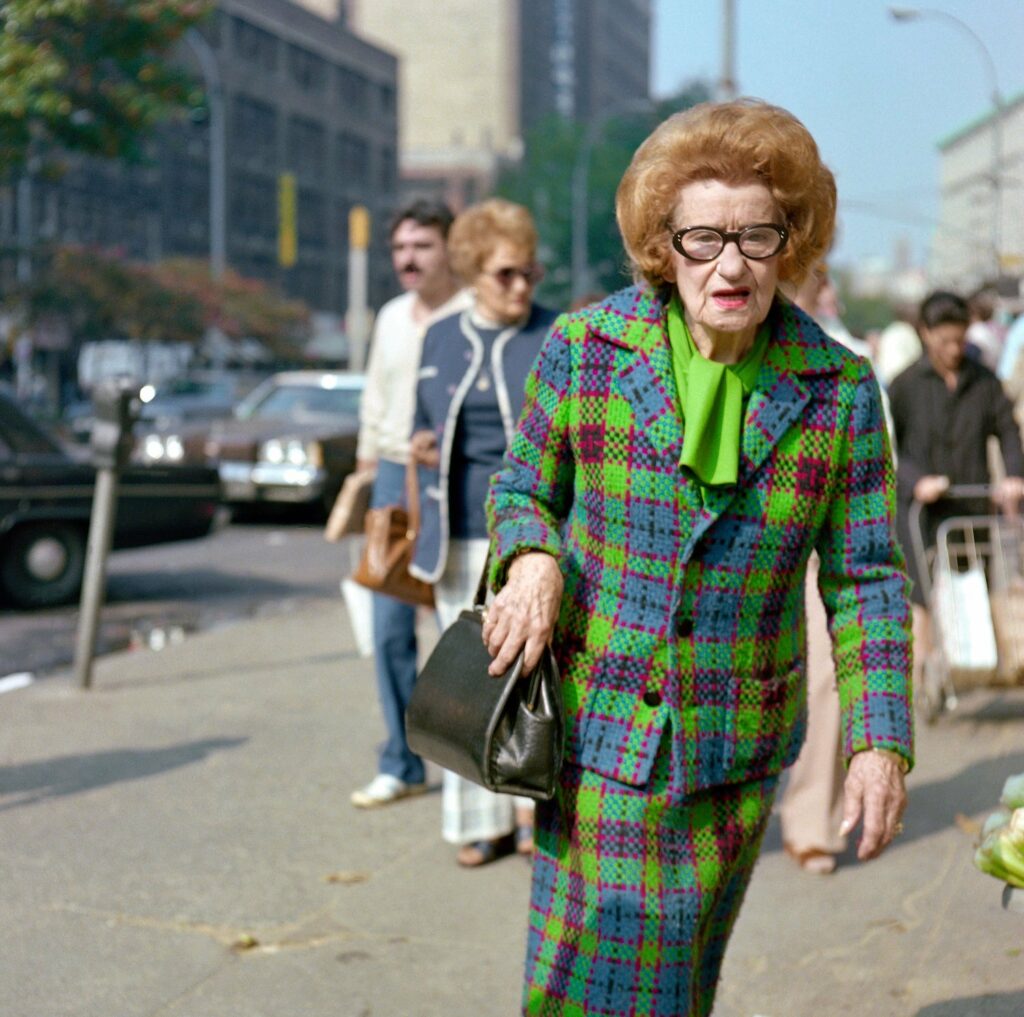
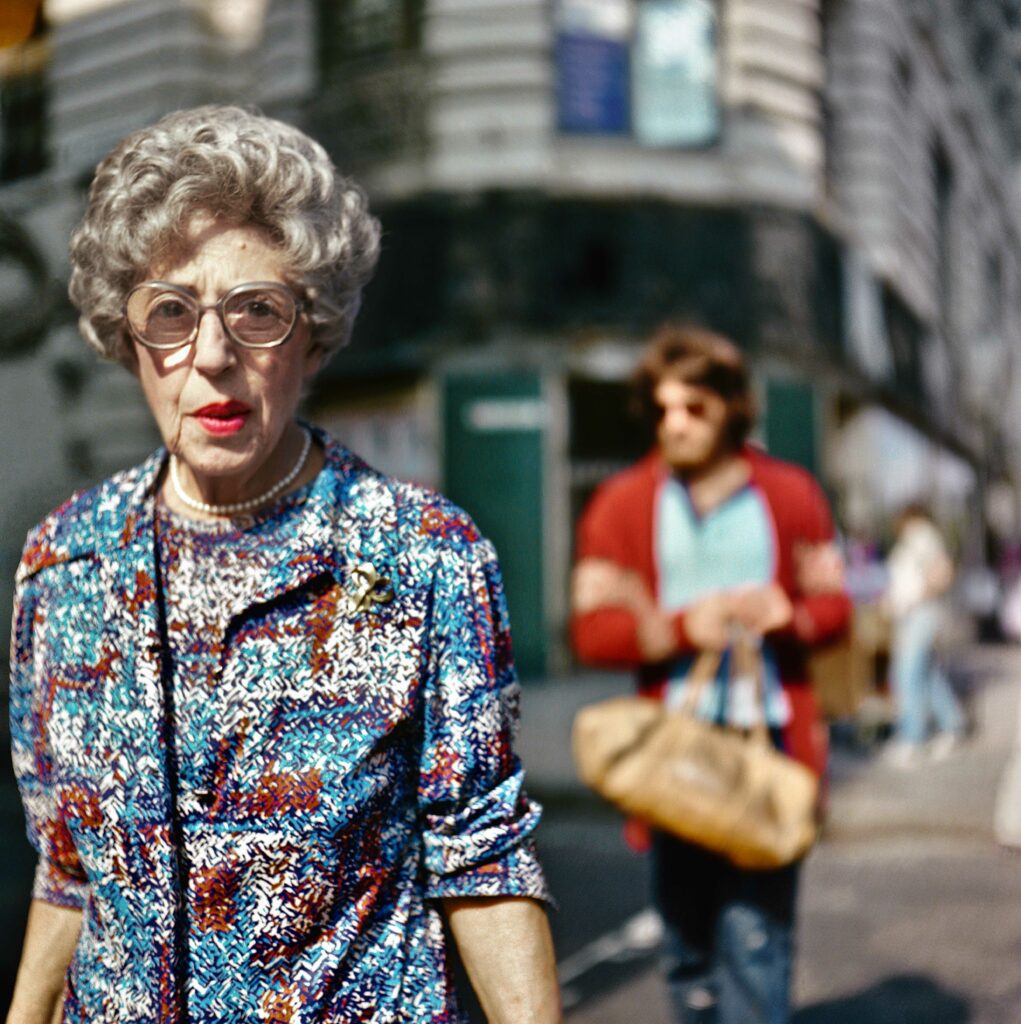
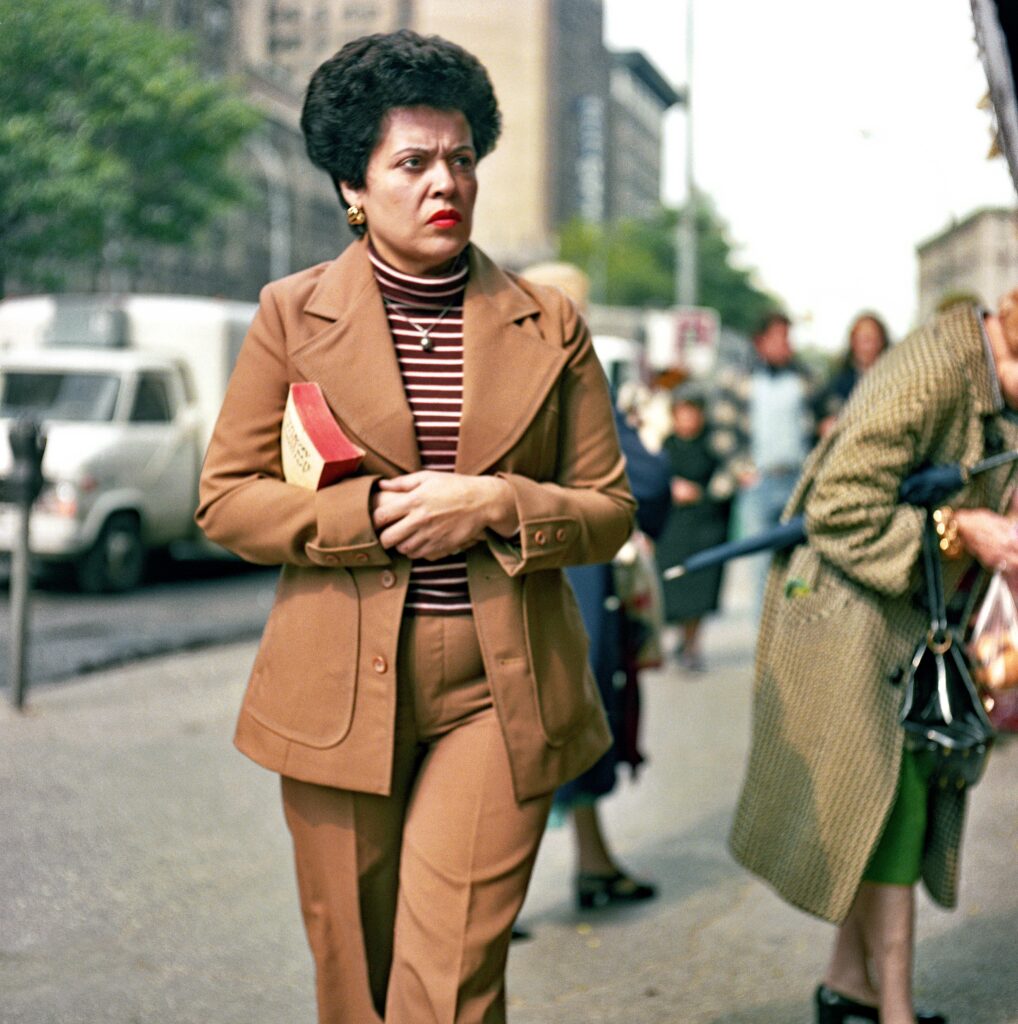
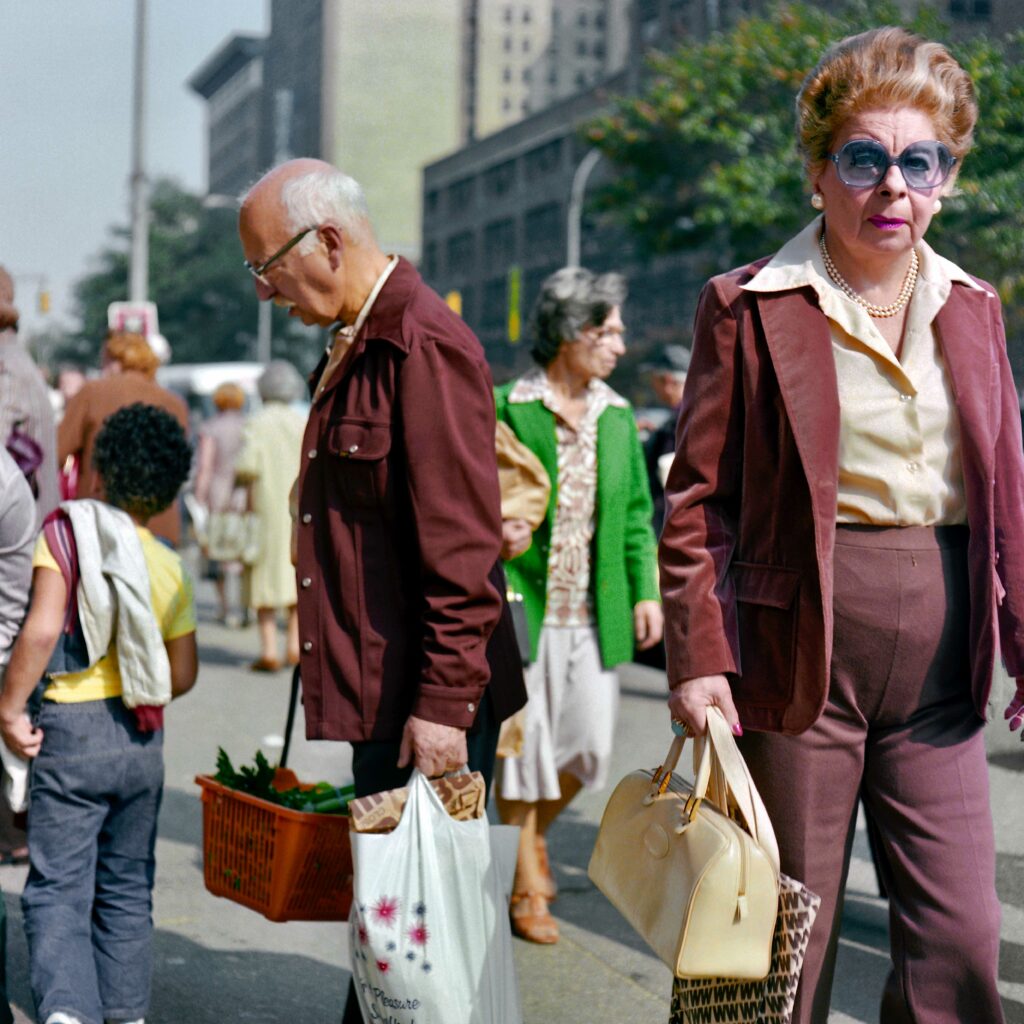
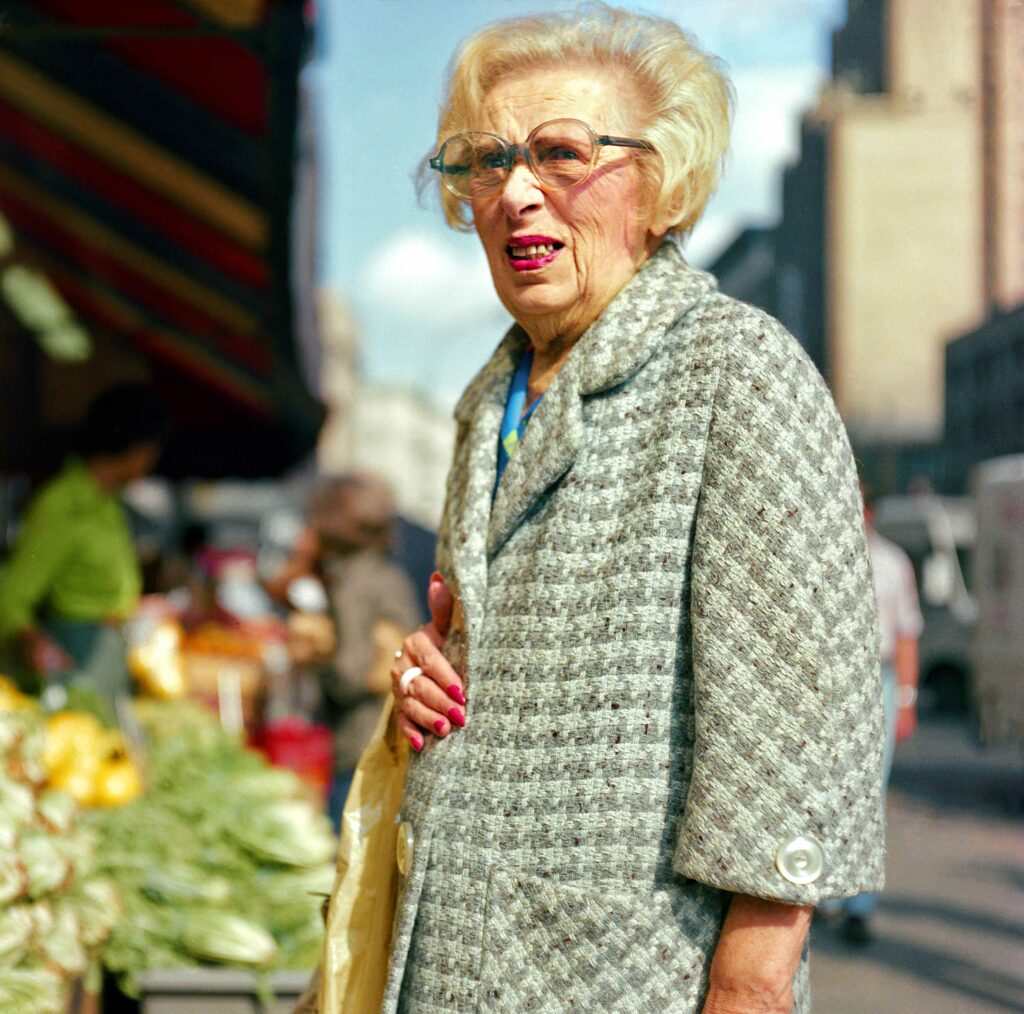
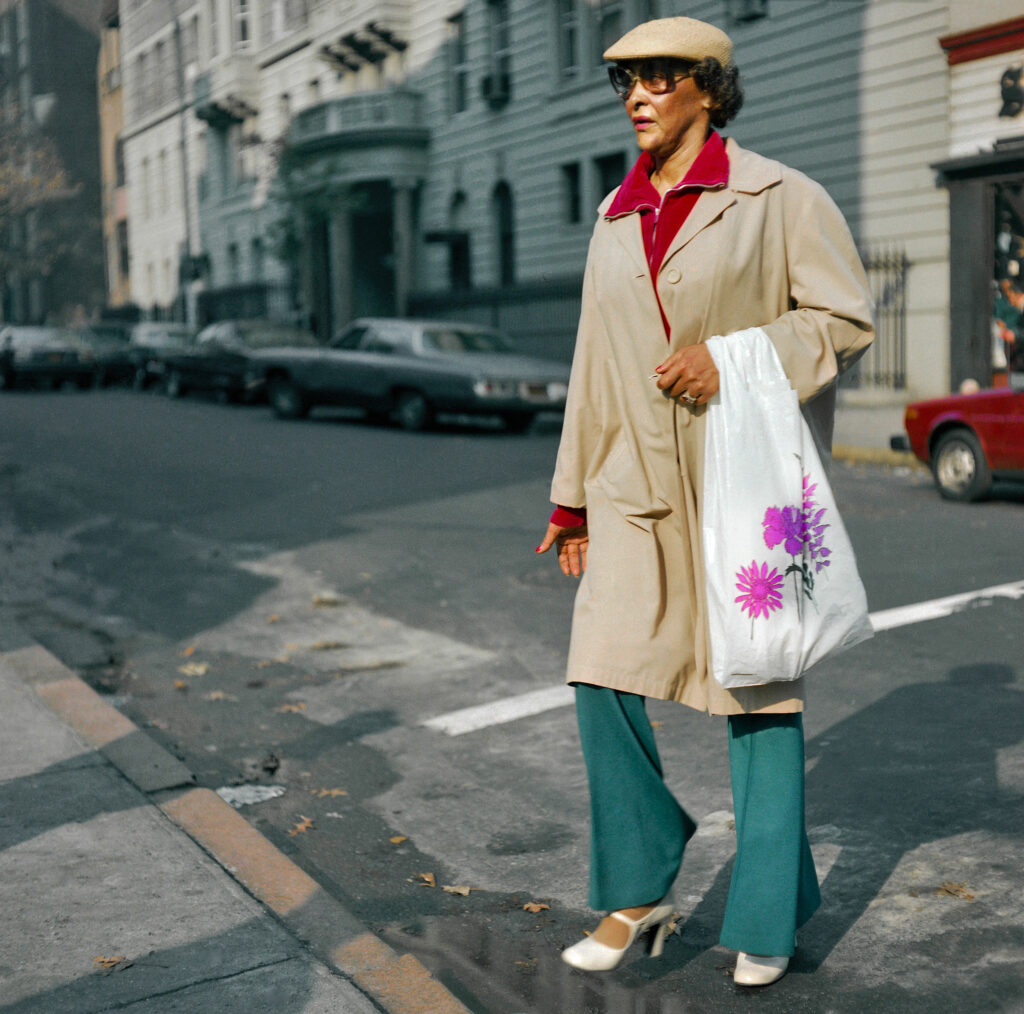
Catherine DeLattre grew up in Monongahela, Pennsylvania, a small town near the heavily industrial area of Pittsburgh. In the late 1960s and early 1970s, she studied archaeology at Kent State where a course in basic photography was a requirement for recording in archaeological digs. That led her to the Art Photography program at Purdue where the focus was on black-and-white, but where DeLattre became more interested in color under the influence of her teacher Vern Cheek, and the then contemporary color work of photographers such as William Eggleston, Joe Maloney, Joel Meyerowitz, Jan Groover, Eve Sonneman and Joel Sternfeld. After a series of teaching gigs that took her from Rockport, Maine to Poughkeepsie, by 1979 DeLattre had saved enough money to move to New York City where she found a $200/month sublet on the Upper West Side and a part time job teaching darkroom at ICP. The colorful, eccentric, mostly elderly, women that shopped and lived in that neighborhood were her first impression of New York City. In DeLattre’s own words, “they looked so put together with makeup, outfits, and hairdos but at the same time so vulnerable. I related to that. I loved how they dressed up to go to the bank and the grocery store and run every day errands.” Almost every day from 1979 through 1980, she shot 120 Kodak color negative film with a TLR Mamiya which allowed her to remain anonymous when capturing street photographs of passersby. “It was an opportunity to photograph a passing generation. … Color was integral to my images in mood and description of the people and time. Color is still my main focus today, although in a more formal way than my street photos of the 1970s and 1980s.” Cay Sophie Rabinowitz
As part of its participation in the PhotoSaintGermain festival, which opens on October 30, 2024, Abraham & Wolff is pleased to exhibit the work of Catherine DeLattre in collaboration with OSMOS, NYC, through a selection of photographs from the series Shoppers, Broadway Upper West Side, NYC, 1979-80.